2009-05-19

More Australian Weather Records Tumble

The Big Dry Down Under just got a whole lot drier. The first three months of 2009 in the already parched Murray Darling basin had the least amount of rainfall since Australian weather records began 117 years ago.

This massive drainage supports $9 billion in agriculture but has been hammered by what some are calling the worst drought in 1000 years. Authorities in Australia make no bones about the cause of this freaky weather.

"We've had big droughts before and big floods before, but what we didn't have was climate change," said Rob Freeman, the chief executive of the Murray-Darling Basin Authority.

The Murray Darling is home to 2 million people who may not even have enough water to survive in the future. "I'd be loath to say that critical human needs will always be secure", warned Freeman.

The recent rainfall record was not the only smashed. Water inputs for three-year period ending March 2009 were less than half of the previous record from the great drought of 1943-1946.

The drainage is so dry that Lake Alexandrina at the mouth of the Murray River is now two feet below sea level. The parched lakebed high in natural sulfides is now exposed to air and oxidizing into sulfuric acid – devastating local ecosystems.

While droughts are normal in Australia, there has never been one as hot as this.

The killer heat wave in January claimed more than 370 lives – more than double the number lost during the worst wildfires in Australian history this February.

Unprecedented temperatures peaked over 45 degrees in Melbourne and averaged 12 to 15 degrees above normal throughout the State of Victoria.

While so-called climate skeptics maintain that climate change is a hoax or a big mistake, Australian firefighters who faced the grim task of battling the worst bush blazes ever came away with a different conclusion.

In an open letter the Australian Prime Minister, the firefighters union called for urgent government action to curb carbon emissions and control climate change:

"Firefighters work in conditions that most of the public try to flee. We often put our lives on the line. We understand that our job is dangerous by its very nature. However, we are gravely concerned that current federal and state government policies seem destined to ensure a repeat of the recent tragic events… Given the Federal Government’s dismal greenhouse gas emissions cut of 5 per cent, the science suggests we are well on the way to guaranteeing that somewhere in the country there will be an almost annual repeat of the recent disaster and more frequent extreme weather events."

Hard to argue with experience like that.

As the Big Dry becomes even drier, there is yet another opportunity to see climate change in action by simply looking out the window. Australia is rapidly becoming a time machine to visit what our warmer world will look like.

2009-05-12

STV is a Bad Fit for Canada

As a long-time advocate of electoral reform, with a heavy heart that I must advise my fellow British Columbians to vote against BC-STV on the May 12th.

BC-STV or “single transferable vote” is a bad fit for Canada, and if adopted here could become a mistake repeated in other provinces with potentially disastrous consequences.

The reason is that STV has an extremely poor record of representing the diversity that Canada is so renowned for, and may in fact lead to even less women being elected than our disgraced “first past the post” system that routinely returns only one in five elected female representatives.

If you watch this video of the Ontario Citizens Assembly process, you will see something that the BC citizens assembly never did. Professor David Farrell of the University of Dublin and authour of the textbook for both the BC and Ontario citizens assembly processes was asked specifically about STV and women during the deliberations in Ontario.

Professor Farrell states clearly that: “there is still this forlorn hope among STV proponents that you are going to find [more women elected under STV someday but unfortunately Ireland and Malta as the only two countries that use single transferable vote are historically right at the bottom of the heap in terms of the representation of women, so it is just not working.

So why would the BC citizens assembly recommend a system that is even worse in terms of representing gender equity (and ethnic diversity) than our current system? Perhaps because they were never directly presented with this important information. Incredibly, gender equity was never part of the mandate of the citizen’s assembly.

This country exemplifies and celebrates diversity more than any other nation on Earth. There may be places that STV would be a better fit, but that place is not Canada.

Malta under STV elects less than 10% women, far worse than even our notoriously gender biased first past the post system. If we are going to bring in the first major electoral reform in North America, why would we want to start with a system that in many ways important to the Canadian character could be even worse than what we want to replace?

Many of these failings of STV flow from the notoriously adversarial system it uses to elect local representatives. In a single riding, literally dozens of candidates must compete for your attention, often of course by slagging their opponents.

People from the even the same political party are in direct competition against each other on a ballot that can be the size of a table cloth. Personalities like Don Cherry prevail. Those like Lester Pearson do not. It is little wonder such a gong show model attracts or elects such a paltry number of female candidates.

Likewise according to Professor Farrell, STV has a poor record of representing minority groups – another core Canadian value – in comparison to list systems like “mixed member proportional representation” (MMP).

So how did we end up in this mess? It is worth reflecting on flawed decision process imposed on the BC Citizen's Assembly in the final days of their determination. After months of mind-numbing expert presentations to lay members, the final crucial decisions were crammed into only two weekend sessions.

The enormous investment of time and effort meant there was little doubt the assembly was going to rightly recommend change. There was also a strong feeling among assembly members that they wanted to present a unanimous recommendation for an alternative model – either STV or the much more established model of MMP that has a comparatively stellar record of representing women and diversity.

In these final days, exhausted members were apparently faced with a small number of representatives (strangely from northern BC that will be very poorly served by STV) who made it clear they would block consensus if the recommendation was the MMP.

The rest is unfortunately history. In spite of the fact that fully 80% of public submissions instead supported some form of MMP, four years and two referenda later we are still stuck with a single choice: STV or nothing.

The good news is that there substantial and growing appetite for electoral reform in BC. The STV referendum in 2005 received 57% support. This was in spite of the fact that 64% of British Columbians knew “nothing” or “very little” about STV according to a Ipsos-Reid poll at the time. A second poll by Nordic Research Group poll on the eve of that referendum showed that only 37% of respondents could even name STV.

This was not for lack of trying. The BC government had mailed a 20-page explanation of STV to all 1.5 million households in the province, followed by a second mailing from the BC Referendum office.

British Columbians were voting for change. They were not voting for STV.

However, the many good people now working hard to promote STV maintain that this may be our last chance for electoral reform in BC. This is simply not true.

Five years ago it was a difficult to find more than a handful of people actively engaged on reforming our electoral system. We have since come a very long way in raising public awareness. Electoral reform is now inevitable in Canada, whether our politicians want it or not.

There is also an bizarre sentiment that STV is somehow a road to MMP. This is nonsense. If you find yourself standing at the front of a church about to be married to someone other than your true love, the time to call of the wedding is now - not after you have bought a house and had three children.

Once we change our electoral system, we will be committed to several election cycles before it can again be changed again. Untangling the mistakes flowing from the final days of citizen’s assembly process 20 years from now will be exponentially more difficult.

We soon will have had two referenda on STV. If this second one again fails, proponents of STV must admit this model is truly a loser and throw their admirable determination behind the alternative MMP model, also developed by the citizen’s assembly.

Incredibly, in spite of two referenda and hundreds of public submissions in support of it, this model has never been presented as a choice to the people of British Columbia.

Change must come to our electoral system. But not change that may make gender and minority representation in Canadian politics even worse.

Mitchell Anderson is a freelance writer based in Vancouver. His late mother Doris Anderson, the former President of Fair Vote Canada, a strongly opposed STV.

2009-04-13

Wilkins Ice Sheet Lost to Climate Change

The latest massive piece of evidence of climate change appeared this weekend - about the size of Jamaica.

The Wilkins ice shelf off the coast of Antarctica finally disintegrated after decades of melting due to global warming. Last year it shrank by 700 square miles of area or about 14% of its size. This huge shelf was held in place by a thread of remaining ice only 500 metres wide.

The Wilkins is by far the largest ice shelf to break away so far and scientists naturally worry that this is a sign of things to come. The southern continent has warmed by 3 degrees Celsius in the last 50 years and the pace is picking up steam

The collapse comes the same weekend as a new study from the Scientific Committee on Antarctic Research (SCAR) showing one third of all Antarctic sea ice will disappear by the end of the century.

The report found that ice coverage on the Antarctic Peninsula alone has decreased by 27,000 square kilometres in the past 50 years.

Early numbers put out by SCAR suggest the collapse of Antarctic sea-ice not only pushes up anticipated sea level rises but will threaten the numbers of native animal species including emperor penguins, humpback whales and several fish species.

Their research also shows sea temperatures in the Southern Ocean are rising faster than in other oceans, and that ice melts in the Antarctic Peninsula and Western Ice Shelf will be greater and more rapid than expected.

"Ice shelves the size of small countries are crumbling away and the latest evidence from the Antarctic is showing that the effects of global warming there are increasing in magnitude," said Rob Nicoll of the Antarctic and Southern Oceans Initiative of the WWF.

Scientists were clealry surprised by how fast Wilkins fell apart. “It’s amazing how the ice has ruptured,” said David Vaughan, a glaciologist with the British Antarctic Survey. “Two days ago it was intact.” Wilkins

The connection with climate change is obvious to researchers who have been studying the area for years. Dr. Vaughan said the breakup up of Wilkins was a "really strong indication that warming is having an effect".

Wilkins was already floating so the latest breakup will not directly affect global sea levels. However researchers believe that land-based glaciers that were held back by the Wilkins ice sheet will now advance more quickly into the ocean.

Researchers last month doubled their estimates for global sea level rise by the end f the century. Places in Northern hemisphere like New York City will be particularly hard hit due to uneven distribution of rising waters and changing ocean currents in the Atlantic.

The new Obama Administration is taking a refreshingly frank view of these changes rather than the years of delay and denial that defined the Bush Whitehouse.

US Interior Secretary Ken Salazar released a statement about the Wilkins collapse saying it "demonstrates once again the profound effects our planet is already experiencing, more rapidly than previously thought, as a consequence of climate change".

This urgent sentiment is echoed by his boss. President Omaba told cheering throngs gathered at Prague Castle this weekend:

"To protect our planet, now is the time to change the way that we use energy. Together we must confront climate change by ending the world's dependency on fossil fuels by tapping the power from the sources of energy like the wind and the sun and calling upon all nations to do their part. And I pledge to you that in this global effort the US is now ready to lead."

What a difference an election makes. Lets hope its not too late for Antarctica, or the world.

2009-04-11

Spin Over Substance in the Oil Patch

Posteriors are puckering throughout the Alberta oil patch as long-overdue climate and green economy legislation moves through the US Congress.

The provincial government has responded by hiring Washington lobbyists at $500,000 per year to try and ensure whatever bill gets passed is so watered down that does not impact the dirtiest oil on Earth.

Premier Ed Stelmach of course frames it differently: "There's so much at stake for Alberta, and we'll be applying a full-court press not only on elected officials but also on the U. S. administration. It's important that Alberta has a way of ensuring the right information gets to the policy-makers and the decision-makers."

What he is worried about is that meaningful cap and trade legislation would further undermine the already marginal economics of the massive tar sands operation.

The foreign market for synthetic crude includes only one country: the United States. Who knew that one day America would move price carbon emissions? Apparently not the operators that have invested billions into the bitumen boondoggle only to see oil prices collapse and cap and trade legislation that will hit the tar sands like a two by four.

Saying this colossal capitial project is exposed on carbon pricing is a mild understatement. Synthetic crude produces at least three times the emissions as conventional oil. These emissions will increase as shallow deposits are exhausted and production moves to non-mining methods. Tar sands emissions already exceed those of 145 nations on Earth.

Any way you slice it, the cap and trade carbon pricing system moving its way through Washington may turn the tar sands into an investment quagmire.

Signs of trouble are already brewing in oil-addled Alberta. An over reliance on the tar sands mean the once-booming economy is going to contract 2% this year. The government is going to run a whopping $1.4 billion deficit for the fiscal year that just ended.

A recent report from the University of Calgary warns that a fixation on oil is leading to massive deficits and draconian government cutbacks not seen in twenty years.

"We criticize (the government) for allowing its budget to become so heavily dependent on volatile, energy-related revenues--that is a high-risk strategy; it has been tried before and has failed, with dire consequences," the report states. "It is a mistake the Alberta government must recognize and take steps to avoid as quickly as possible."

Interestingly, the highly touted “carbon capture” (CCS) solution for the tar sands has also been widely rejected by the marketplace. Nine out of twenty oil companies picked by the Alberta government to access a massive $2 billion fund to develop this dubious technology have since pulled their bids.

Such tar sands heavy weights as Suncor, Syncrude, ConocoPhillips and StatoilHydro decided this “solution” wasn’t worth their investment dollars, even if the taxpayer was also shelling out billions. This outcome is consistent with a secret government memo last year that said that CCS had very limited application for tar sands operations.

That of course has not stopped the Alberta or Canadian government from continuing to talk up the idea, particularly with the US administration. You can the bet the recent influx of public lobbying dollars into Washington will only amp up the decibels.

What’s that spinning sound I hear?

2009-04-10

Climate Change a Hoax After All

I'm sorry. What more can I say?

It was just revealed that so-called climate change actually is a hoax, perpetrated by that fiend Al Gore.

Numerous luminaries in the scientific community owned up with their own mea culpas when the gigantic ruse was revealed on this day, April 1, 2009.

With the exception of a few visionaries, virtually every scientist on Earth was taken in by the former Vice President’s compelling power point presentation. The humiliation was palpable.

“I am deeply ashamed for having unwittingly perpetuated such a massive fraud on the governments of the world,” said Dr. Rajendra Pachauri, Chair of the IPCC, calling the grand climate hoax a “cunning deception spanning decades”.

“I have to admit, Al got me good,” said NASA’s Dr. James Hansen as he packed up his personal belongings at his office at the Goddard Institute for Space Studies in New York. “Despite my decades of experience in climate modeling and satellite meteorology, I would just get mesmerized whenever Gore started showing me all those fancy charts and tables. The man is a real Svengali.”

In another stunning development, a clearly chagrinned Nobel Committee revoked the peace prize granted to Gore and the IPCC in 2007, and instead honored the signatories of the Oregon Petition whose remarkable insights eclipsed that of the entire scientific community.

Reached for comment, Al Gore was clearly unrepentant of his heinous acts: “As long as I can remember, my only goal in life has been to destroy free-market capitalism and replace it with global totalitarian socialism. But it seemed that traditional methods, such as guerrilla warfare, were proving unsuccessful. Then, one day in 1988, as I was strolling through the halls of my giant mansion, it hit me: carbon dioxide.

For a full report of these stunning developments, see this article in the Christian Science Monitor.

I extend my heartfelt apologies to those visionary skeptics who, as it turns out, were right all along.

Our Friend CO2

One of the stupider arguments making the rounds in the media is that “carbon-dioxide-is-not-pollution– it’s life”.

In fact, the Competitive Enterprise Institute (CEI) produced a hilarious commercial saying just that.

Friendly footage shows how CO2 comes from little girls blowing dandelion seeds, and prancing gazelles. Then cue the ominous music: “now some politicians want to label carbon dioxide a pollutant – imagine if they succeed. What would our lives be like then?

Perhaps a bit of back-story is in order. The CEI has received a whopping $2,005,000 from ExxonMobil since 1998. Their point person on climate change is the notorious Myron Ebell who is so pathologically pro-oil he once claimed that good gas mileage is a mass killer.

So what are the CEI (and their funders in the fossil fuel industry) so worried about? After decades of the atmosphere being used as a free dumping ground for astronomical amounts of carbon dioxide, the federal government is finally considering putting some regulations on our friend CO2.

It is no surprise that this proposed policy is about as popular with Big Oil as a fart in a diving bell.

The fight around CO2 regulation has been brewing for a long while. Back in 2007, the US Supreme Court found the EPA was negligent in not listing CO2 as a legally defined “pollutant” under the Clean Air Act. This designation would trigger long overdue regulation of carbon emissions – something the Bush Whitehouse was predictably opposed to.

Years of delay ensued where essentially nothing happened, other than climate change became exponentially worse. Interestingly, Myron Ebell of the CEI was accused of colluding with the Bush Whitehouse to discredit elements within the EPA that wanted to move forward with CO2 regulation.

Pitted against this immovable object was a seemingly unstoppable force. Barack Obama was elected President, and change ostensibly came to Washington.

Just last month the EPA finally submitted their carbon dioxide determination to the Whitehouse, deciding that CO2 meets the legal definition of “pollution” based on the well-known impacts climate change will have on human welfare, and almost everything else on the planet.

This is a first step on a long road towards recognizing that using the atmosphere as an unregulated dumping ground for CO2 is not only dangerous, but unfair to the taxpayer who will have to pick up the tab as our climate chickens come home to roost.

While CO2 does not stink or make your eyes burn – it is definitely dangerous in the amounts now emitted around the world:

  • Climate change from burning fossil fuels has been identified by experts as a greater threat to humanity than global terrorism.
  • Leading researchers testified before Congress just last month that large parts of the United States may be rendered an uninhabitable wasteland – perhaps within the next ninety years.
  • Dr. Nina Fedoroff, the chief scientist for the US State Department testified last week that carbon-driven climate change could leave one billion in famine in only forty years.

Historic CO2 concentrationsAll this is being driven by ballooning levels of CO2 that have not been seen in the Earth’s atmosphere for at least the last 800,000 years.

If all that isn’t dangerous, I don’t know what is.

Rather than reinventing the wheel, why not use legislation already on the books?

The venerable Clean Air Act remains one of the most powerful tools to begin making polluters pay for the well-known impacts of climate change.

But then, what polluter wants to pay for anything? Big Coal and the oil industry are pushing back hard.

Last year, the coal industry threw $45 million at a public relations campaign, and more than $10 million on lobbying. This was largely to promote the fiction of “clean coal” to the pubic, the media and lawmakers.

Hence the ridiculous argument being puffed up in the popular press that CO2 is merely a harmless gas exhaled by little girls and gazelles.

For the record, no one is disputing that historic levels of CO2 are essential for life as we know it. It is routinely added in greenhouses (and grow-ops) to boost production.

But as they say, a little dab will do ya. Too much of a good thing, be it water, whiskey or botox will kill you. The trick is knowing how much is too much.

Of course the fossil fuel industry would like the bartender to keep pouring a long while yet. And as with any drunk, rational conversation is not always possible. Sometimes the best way to keep the party going is denying there is a problem.

You can therefore expect to hear much more nonsense from the fossil fuel lobby about our invisible, harmless friend CO2.

2009-04-08

NASA Reneges on Transparency - Still No DSCOVR Documents

It was welcome news last month when Congress committed $9 million to refurbish the long-overdue Deep Space Climate Observatory

(DSCOVR). Good start. So how about some information to go with it?

Desmog blog readers will recall the long and fruitless quest to wring documents out of NASA about the bizarre story of the DSCOVR spacecraft. This $100 million instrument was fully completed eight years ago yet has been sitting in a box in Maryland ever since.

DSCOVR was designed to directly measure climate change for the first time ever by observing our warming planet from the unique vantage of the Lagrange Point - one million miles towards the Sun.

The climate denial industry has been regularly harping on the unreliability of low Earth orbit satellite data for years. Strange then, how the very experiment that could resolve such issues was mothballed – over the strenuous objections of dozens of leading researchers.

I struggled for over a year to extract any kind of internal documents from NASA using the Freedom of Information Act and got nowhere. After 11 months of stonewalling, the space agency elected to withhold an unknown number of documents due to some very bizarre rationales. I appealed later in 2007 and was also turned down.

Then Barack Obama was elected President of the United States.... One of his first actions, only one day after inauguration was to issue a memorandum to the heads of every federal agency directing them to err on the side of disclosure and openness. The legally binding statement ordered among other things that:

The Freedom of Information Act should be administered with a clear presumption: In the face of doubt, openness prevails. The Government should not keep information confidential merely because public officials might be embarrassed by disclosure, because errors and failures might be revealed, or because of speculative or abstract fears. Nondisclosure should never be based on an effort to protect the personal interests of Government officials at the expense of those they are supposed to serve.

What a breath of fresh air. I decided to take President Obama at his word and re-submit my FOIA request to NASA the next day.

To make it easy on the beleaguered space agency, I kept the wording almost identical. In effect, all they would have to do is look at the already collected documents from my original request, glance at the presidential directive from Mr. Obama and release most or all of the long-withheld documents.

So what happened next? Absolutely nothing.

More than two months have gone by and I haven’t heard a peep from NASA in spite of numerous emails asking for an update on the status of my request. Maybe they didn’t get the memo…

Alas there was another directive just last week from the new Attorney General Eric Holder, overturning a draconian directive from John Ashcroft in the wake of 9-11. This new policy again instructs the heads of all federal agencies to pull back the veil of secrecy that has plagued the US government for years. Specifically, this policy states:

“The Freedom of Information Act (FOIA), 5 U.S.C. § 552, reflects our nation's fundamental commitment to open government. This memorandum is meant to underscore that commitment and to ensure that it is realized in practice.”

Holder also makes it clear that hiding behind legal technicalities is unacceptable:

“An agency should not withhold records merely because it can demonstrate, as a technical matter, that the records fall within the scope of a FOIA exemption.”

That bureaucratic game playing is a thing of the past:

“FOIA professionals should be mindful of their obligation to work "in a spirit of cooperation" with FOIA requesters, as President Obama has directed. Unnecessary bureaucratic hurdles have no place in the "new era of open Government" that the President has proclaimed.”

The Attorney General also demands that requests be handled as quickly as possible:

“When information not previously disclosed is requested, agencies should make it a priority to respond in a timely manner. Timely disclosure of information is an essential component of transparency. Long delays should not be viewed as an inevitable and insurmountable consequence of high demand.”

In light of all that, my question to NASA is quite simply: where are my documents??

I have been more than patient for the last two months, filed a very modest request that does not require any additional document searches, and have made several failed attempts to get an update on the status of FOIA request FOIA-09-070.

The ball is your court NASA. What do you have to hide?

2009-04-04

Slavery, George Will and Light Bulbs

History is punctuated by tipping points. And at each of these transitions there are those resistant to change – raising their voices in support of they way things were or spreading fear about the emerging new era.

William J. Grayson was a respected lawyer, politician and poet in 19th Century South Carolina. Of impeccable American pedigree, his father was aide-de-camp to George Washington during the War of Independence. On the eve of the civil war, he bravely spoke out against the secessionist movement that was so popular in his home state.

Grayson was also a vocal defender of slavery, stating in 1855:

“What more can be required of Slavery, in reference to the negro, than has been done? It has made him, from a savage, an orderly and efficient labourer. It supports him in comfort and peace. It restrains his vices. It improves his mind, morals and manners. It instructs him in Christian knowledge.”

History is a cruel judge. The many prominent citizens of the day resistant to abolishing the ancient and accepted practice of buying and selling humans are now seen a greatly diminished light.

Into that storied company strides George Will of the Washington Post. Graduating from Princeton with a Ph.D in politics, he is a Pulitzer Prize winning journalist, author of numerous award-winning books, a former instructor at Harvard. As a commentator, scholar and journalist, he has achieved virtually everything that can be in his many chosen fields of endeavor.

And like William J. Grayson, Mr. Will finds himself squarely on the wrong side of a defining shift in history. As the world makes its first tentative steps to deal with our collective climate crisis, Will is instead lending his considerable credibility to resisting that change.

There is no doubt that fossil fuels - like slavery– have provided a cheap and convenient source of energy. And like slavery, it is long-established norm that is rapidly becoming morally indefensible.

Virtually the entire scientific community is speaking in unison when they warn of famine, drought, mass displacements, global instability, and an impoverished future unless we take concrete and immediate steps to wean our economy off a reliance on fossil fuels. Dealing with climate change is abolition equivalent of the 21st. century.

Such fundamental shifts in society are difficult enough without specious arguments from prominent opinion leaders like Mr. Will questioning even the scientific imperative for change.

Yet Will has done just that, holding forth on subjects well outside his areas of expertise such as sea ice and polar meteorology. He has embarrassed himself and the Washington Post by publishing clearly erroneous claims about our changing climate, then repeating those claims when challenged even by the very scientists that collected the data he was misrepresenting.

His latest straw man are light bulbs. In an article this week, Mr. Will descends into anecdotal arguments of how compact florescent light bulbs don’t last as long as they should, are difficult to dispose of, and somehow all this is the fault of our government’s reckless haste to move on climate change.

That anyone of Mr. Will’s stature could seriously accuse government of pell-mell panic on climate change is quite simply laughable.

For over almost two decades, the scientific community has been hectoring world leaders that carbon emissions pose a real and immediate danger to society, global security and the economy. They have stated clearly and repeatedly that the longer we wait, the more difficult and tragic will be the outcome.carbon emisisons

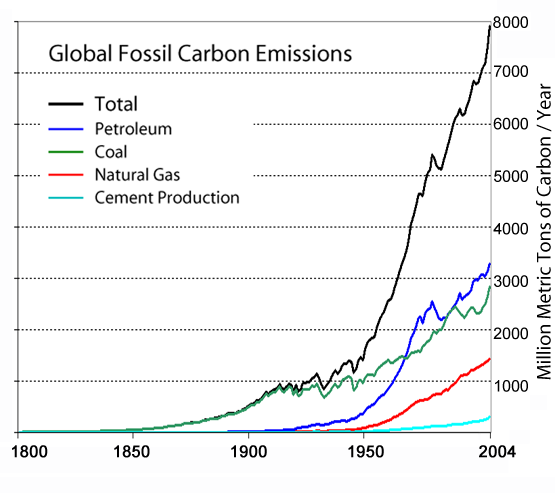
And for years, carbon emissions have marched relentlessly upwards - recently accelerating beyond even the worst case scenarios considered by the IPCC.Leaders meet, words are spoken, nothing changes.

Beyond the obvious economic, political and technical challenges of shifting the world away from fossil fuels, is perhaps the greatest challenge of all: public opinion.

The voting and consuming public remains scandalously ill informed about our emerging understanding of climate science. This makes the hill far steeper for those few political leaders willing to blaze a way forward into a new era.

George Will and the Washington Post are shamefully culpable in this situation. They have contributed to inaction at the very moment of history when action is imperative.

There is no doubt that Mr. Will, like William J. Grayson, is a distinguished and accomplished citizen. And like his predecessor of the 1800’s, people a hundred years from now may instead remember him only for being on the wrong side of history.

2009-04-03

David Bellamy Gets It Completely Wrong on Climate Change Science

There’s another strong contender for the Christopher Booker Prize for Bullshit Reportage of Climate Science.

The latest challenger is David Bellamy, a former BBC broadcaster who has been holding forth on his rather hostile views on climate science.

In a video interview with a British newspaper, he calls peer-reviewed journals as “the last thing I would use now.”

Huh?

If Bellamy has indeed written off the entire scientific community, where is he getting his information to back up his remarkable claims that carbon emissions are not driving climate change?

Hard to say… George Monbiot does an admirable job of trying to unravel Bellamy’s convoluted arguments in an article last week. Let’s try and follow the faint trail of breadcrumbs dropped by the UK’s leading climate change denier.

Among other things, Bellamy maintains that a much warmer climate 2,000 years ago allowed Romans to produce “very very good red wine up in the Scottish borders.”

True? Ah…no. Here is a map of the extent of historical wine production in the UK including both the Roman and Medieval periods, published by Richard Selley, author of The Winelands of Britain.Vineyards of UK

The good news (if you can call it that) is that Scotland may be promising vineyard habitat by the end of the century due to ballooning emissions of fossil fuels.

The “fine wine” argument instead buttresses the already colossal amount of evidence that the kind of climate change we are now witnessing eclipses anything seen in the historical record.

Bellamy also contends that the famous graph produced by Dr. Michael Mann had been “taken apart and proven to be a fiddle” - a charming turn of phrase but of course entirely wrong.

The so-called “hockey stick” graph has been recalculated several times using updated data and always shows the same thing: that the climate we are experiencing now is warmer that anything in recorded history. According to the US National Academies of Science assessment of this “controversy”:

The basic conclusion of Mann et al. (1998,1999) was that the late 20th century warmth in the Northern Hemisphere was unprecedented during at least the last 1,000 years. This conclusion has subsequently been supported by an array of evidence that includes both additional large-scale surface temperature reconstructions and pronounced changes in a variety of local proxy indicators, such as melting on icecaps and the retreat of glaciers around the world, which in many cases appear to be unprecedented during at least the last 2,000 years.

Bellamy may instead be referring to a fraudulent graph produced by a German high school teacher that was cribbed from an early draft by the IPCC way back in 1900. This cut and paste fakery involved phony temperature scales, extended timelines and amusing claims that the fake graph was correct and the entire IPCC process was wrong. It was also promoted to many schools in Germany.

For a knee-slapping account of this flim-flammery see this account from Realclimate.org.

Bellamy also repeats a favorite refrain of climate deniers that the ice core data shows a lag between temperature increases and CO2 increases. According to him, this indicates the link between CO2 and temperature is all a bunch of hooey.

First of all, ice core data from Greenland and Antarctica dating back many hundreds of thousands of years shows that global temperatures move in lock step with atmospheric CO2 concentrations. Obviously, there is a very strong link between the two.

Secondly, scientists are not maintaining that ancient increases in temperature were initiated by increasing CO2.

For one thing, mastodons or our ancient primate ancestors did not drive cars or excavate and burn massive amounts of coal – that is something we are doing for the first time in geologic history. Prehistoric temperature increases were instead started by changes in the Sun’s output or the Earth’s orbit, and then amplified up to five times by the release of carbon in positive feedbacks like melting permafrost or CO2 release from warming oceans.

Third, this extensive ice core record is not something we should take comfort from. We are already seeing evidence of dangerous positive feedbacks which may lead to runaway climate change, whether we in the future decide to drastically reduce CO2 emissions or not. Once we start the train moving, it may pick up speed up even as we try and put on the brakes.

Speaking of ice, Bellamy also claimed in a letter to the New Scientist in 2005 that many of the world’s glaciers “are not shrinking but in fact are growing ... 555 of all the 625 glaciers under observation by the World Glacier Monitoring Service in Zurich, Switzerland, have been growing since 1980"

His nemesis George Monbiot took the time to contact World Glacier Monitoring Service and read them Bellamy’s letter. Their response? "This is complete bullshit…Despite his scientific reputation, he makes all the mistakes that are possible."

It gets worse. Turns out that Bellamy’s “source” likely originated from a website hosted by none other than S. Fred Singer. This professional denier who has worked on behalf of the CFC, tobacco, and oil industries was ostensibly citing a “paper published in Science in 1989", stating that 55% of glaciers were growing.

Monbiot tried to find such a paper but it does not exist. This phony claim about growing graciers has been making the rounds on the internet for years and was finally put to bed by Desmog Blog last July.

It also turns out that Bellamy apparently meant to type “55%” but missed the shift key and got 555 instead. Bellamy later admitted to a “glitch of the electronics” regarding his letter to the New Scientist, yet never requested a correction be published.

So much for the robust case against climate science.

2009-04-01

The Heartland Institute's Skeptic Handbook - Get Out the Shovel...

Most climate denial material is all over the map so it is a pleasant change to have a nice clear target.

I am talking about the "Skeptic’s Handbook" that the notorious Heartland Institute is helpfully printing 150,000 copies of for distribution across the US including 850 journalists, 26,000 schools, “19,000 leaders and politicians”.

The mass printing of this climate propaganda piece is being funded by an “anonymous donor”. It is odd that “someone” feels strongly enough to shell out that kind of money but also wants their identity concealed. We do know that the Heartland Institute has been bankrolled to the tune of $676,000 from ExxonMobil since 1998. Nuff said.

It is also interesting that this latest product of the denial machine is washing over the nation less than a month after the US government released their Climate Change Literacy brochure – cosigned by 13 federal agencies and 24 educational and scientific partners.

Membership in the supposed climate change conspiracy now includes such well known eco-freaks as the Department of Defense, the Department of the Interior and the US Forest Service.

The handbook itself is hilariously illogical. It coaches “skeptics” to avoid talking about the evidence of changing climate - for obvious reasons presumably. According to them, something may be heating things up, its just not carbon dioxide. Independent thinkers are instead counseled to follow these four cookbook points:

  • The greenhouse signature is missing
  • Ice Cores do not support carbon as a driver of climate change
  • Temperatures are not rising
  • Carbon dioxide is doing almost all the warming it can do.

All of these points are either entirely wrong or grossly misleading. Lets get out the shovel and start unloading this pile of manure.

The greenhouse signature is missing

Flat out wrong.

There is a clear signature that greenhouse gases are warming the atmosphere and has been for years. If you thought that the scientific community had picked over this issue pretty carefully for about 100 years, you would be right. Hundreds of studies have looked at this question using mathematical analysis, laboratory studies and atmospheric observation. Modeling based on this data agrees very well with what we are seeing.

There are several drivers of temperature change on Earth, including atmospheric sulfatesclimate model, volcanic ash, fluctuations in the ozone layer, changes in the Sun and greenhouse gases. Here’s what the modeling and direct observations shows:

The “missing hotspot” argument is also a favourite red herring that pops up perennially from deniers like a game of whack-a-mole.

First of all, the hotspot is not missing. Secondly, is not a signature of the greenhouse effect, it is the signature of warming from any source.

As a matter of fact, the warming profile of the atmosphere is exactly what you would expect from the greenhouse effect due to carbon emissions – namely a hotter lower atmosphere and a colder stratosphere.

Sorry deniers – that one is tossed in the tank yet again.

Ice Cores do not support carbon as a driver

Grossly misleading. Ice core data shows a very strong link between atmospheric carbon and global temperatures. What the deniers are harping on is that it appears that carbon does not start the warming, it only amplifies it.

atmospheric carbon signatureBelieve me, this is nothing to take comfort from. Ice core data dating back hundreds of thousands of years clearly shows that once warming is started due to regular fluctuations in the Earth’s orbit or solar output, it leads to massive increases in atmospheric CO2 from melting permafrost and release from the oceans. This in turn leads to positive feedbacks that amplify warming by up to five times.

The difference now is that we are jump-starting warming by dumping huge amounts of ancient carbon into the atmosphere by burning fossil fuels. This is already leading to positive feedbacks like melting permafrost, and increased forest fires.

The other scary difference is that scientists believe that this time we may push past tipping points like melting the Greenland ice sheet that the planet has not seen in a long, long time. Sound like a good idea? Maybe we shouldn’t give it a try.

It is also amussing that deniers say that atmospheric carbon dioxide has nothing to do with warming, while also maintaining that it does, but it dosn't matter. You try and figure out what they are saying - I can't.

Temperatures are not rising

Politely put, this is complete crap. The clear trend is upwards and has been since about 1900 with a large increase since 1980. global temperaturesHere is the latest world land temperature graph from NASA – decide for yourself whether things are getting chillier.

What climate deniers love to do is cherry pick the data by starting counting in 1998 – the warmest year in the history of meteorology and one of the strongest El Nino years on record.

Another hoary old myth is the urban heat island effect – that weather stations that used to be far off in the country are now in the city surrounded by pavement and air conditioners. Believe it or not, scientists actually thought of that.

Still don’t believe the entire scientific community? Have a look at the latest graph of global temperatures for both land and oceans. Not many air conditioners floating around sea.

land ocean temperaturesCarbon dioxide is doing almost all the warming it can do

Absolutely false. Saying increased atmospheric carbon is not going to make a difference is like suggesting that throwing more wood on a fire will not make it bigger.

It is true that high school physics shows that CO2 warming in the atmosphere follows a logarithmic relationship – meaning that heating from increasing CO2 does not follow a straight line. That is precisely why scientists instead talk about an atmospheric doubling of CO2 (yes, they’ve thought of that tooprehistoric atmospheric CO2).

Climate models predict that every additional doubling will lead to global warming of about 3°C – but some estimates put it as high as 6°C. I guess we’ll find out…

In the last 150 years, we have increased atmospheric carbon from 280 ppm to 385 ppm, and the pace is picking up speed. We are on track to hit 530 ppm by 2050.

To see what all these numbers mean, have a look at this animation from the Bjerknes Centre for Climate Research in Norway.

Of course a real scientist making such baseless arguments among their peers would be laughed out of the room. That is why you will never ever see climate deniers make their claims in the scientific literature – only in the mainstream media. Meanwhile the voting public remains dangerously confused by this garbage. As they say, tick tock goes the clock.

The Denier’s Handbook was written not by a practicing researcher of course, but by a woman named Jo Nova whose past vocations included hosting of children’s program in Australia and touring Australia with a science circus sponsored by Shell Oil. Interesting, her former funder (the oil company) is no longer denying the link between carbon emissions and climate change in their communications with kids. Maybe she didn't get the memo.

She has at least one science-related publication to her credit: Serious Science Party Tricks ($14.95 AUD plus $2.50 postage). It does not directly relate to atmospheric chemistry however. It instead documents how to:

“Do the funniest, silliest, and most surprising tricks with things like paper, balloons, straws and flour. Simple, quick, easy and stunning. An activity book to keep you engrossed for hours!”

Hardly peer-reviewed stuff. I do not mean to disparage children’s literature, but these patently false claims are going to be distributed to 16,000 decision-makers and politicians and frankly she is asking for it.

It is also interesting that almost all of these augments seem to originate from our “rocket scientist” friend David Evans. Real climate scientists in Australia were tearing their hair out when he kept popping up in the media Down-Under claiming to have an expertise in climate science. FYI – he has not published one single peer-reviewed paper in the field.

For some excellent critiques of these old and erroneous talking points see the blog of Dr. Barry Brook, a climate scientist from the University of Adelaide, and Dr. David Karoly at the University of Melbourne. There are good eviscerations of Nova's "arguments" here.

The old field of climate science misinformation blooms anew – well fertilized by ““anonymous donors” and of course the fossil fuel industry.

2009-03-26

Death to the CBC!

Lorne Gunter recently vented his spleen about the CBC, and the National Post blowhard is clearly feeling a little threatened by the beleaguered national broadcaster.

"The CBC will never be able to exorcize its left-wing missionary zeal -- for global warming, for Islam, for big government, Barack Obama, multiculturalism, public health care, human rights commissions and so on. And it could never survive on private donations or ad revenues. So the only thing to do with Mother Corp is to pull down its office buildings and stations and pour salt in their foundations."

Besides the other perceived sins of zeal for Islam, Obama and public health care, Gunter has the gall to call for the abolition of our seventy-three year old national network due to their comparatively impeccable coverage of climate science.

I am flummoxed by my inability to describe just how dishonest and absurd Gunter’s argument is. Bear with me as I struggle to scale this seemingly insurmountable peak.

Desmog Blog readers know well how we feel about the monotonously inaccurate coverage by the National Post about the scientific understanding of climate change. I struggled to itemize all the factual errors in one single article by Gunter and could not do the subject justice in under 800 words.

On the suggestion of a Desmog Blog reader, I happily nominateChristopher Booker Prize d Mr. Gunter for the Christopher Booker Prize for Bullshit Reportage of Climate Science, sponsored by George Monbiot and the Guardian. Godspeed Mr. Gunter – I am rooting for you.

His employer, the National Post felt it important to send reporters to the climate deniers conference in New York, sponsored by the hilariously unethical Heartland Institute. In contrast, they neglected to send correspondents to either the UN Climate conference in Poznan Poland, or the recent gathering of 2.500 of world’s leading climate scientists in Denmark.

I could go on but you get the point. I make no claim of being a brilliant researcher, but I must say unearthing the abundant errors in the work of Mr. Gunter and other staffers at the Post has been like shooting fish in a barrel with a RPG.

Now why would that be? Professional journalists are typically superb at research, fact checking and correctly citing sources – assuming they want to. In deference to their obvious skills as media veterans, one can only ask the pregnant question: are they instead willfully misleading their readers?

Which brings us to the end game of Mr. Gunter’s latest offering to his readers. There is more at play than the obvious irony of Gunter calling for the biblical destruction of the CBC due to their accurate reportage of climate science.

Canwest graphHis employer Canwest Global Communications has raked up a crushing debt of $3.7 billion. Their share price languishes around $0.30 – after plummeting more than 97% in value in the last two years.

After two humiliating meetings with impatient creditors, their latest deadline to pony up interest payments of $30 million is April 7. What to do?

Rather than cutting costs, selling assets, or running a responsible and profitable business, CanWest has instead hired a close confident of Prime Minster Stephen Harper to negotiate some manner of structural bailout for the beleaguered media empire.

A deal straight out of the PMO would likely take the form of sweeping tax breaks or gutting regulations that would be music to the ears of Lorne Gunter and his ilk.

Meanwhile, the CBC, that has irritated and enraged the Harper government by responsibly representing climate science to the Canadian Public, has been allowed to hit the ground with a splat. Just today they announced the elimination of 800 staff positions and the sale of $125 million in assets just to keep the doors open.

No wonder.

Last year they revealed the Harper government was not being truthful when they shoveled $2.5 billion of taxpayers dollars towards the baseless band-aid of carbon capture to alleviate massive emissions from the Alberta tar sands.

Harper himself is a receptive audience for the type of climate tripe trotted out almost daily by the National Post. He referred to Kyoto a “socialist scheme designed to suck money out of wealthy nations”. This remarkable story was also broken by the CBC.

The CBC also did fine work revealing the inner workings of the Denial Machine – perhaps the most sinister public relations campaign in history, and very reason this blog was started.

And where does the rubber hit the road in such a PR campaign? Nothing as clumsy or obvious as a full page ad paid for by oil companies.

Instead it manifests in columns such as those obediently penned by the likes of Lorne Gunter, referencing the work of “a cadre of scientists who share the industry's views of climate science… trained in public relations so they can help convince journalists, politicians and the public that the risk of global warming is too uncertain to justify controls on greenhouse gases.

Back to Lorne Gunter’s rant against the CBC. He is not merely angling on behalf of his employer in the high-stakes backroom lobbying now going on in Ottawa.

He is also campaigning in his column that one the finest foils to the dangerous drivel produced by himself and others around climate science should be dispensed with by our oil-friendly Prime Minister.

I doubt Mr. Gunter cares that much about the CBC’s coverage of Obama, healthcare or Islam. Like a teenage boy hoping to nonchalantly buy condoms at the neighborhood drug store, he has arrived at the cashier with some pop, magazines and toothpaste.

What he and the rest of the denial machine are threatened by is responsible accurate reporting on climate science – something the CBC has proven dangerously accomplished at.

Keep an eye on April 7. With such an oily regime in Ottawa, Mr. Gunter may soon get his wish.

2009-03-24

Saying Sorry is Hard to Do (Maybe I Can Help)

Lorne Gunter was wrong.

How can it be? For someone that has spread such a load of manure about climate science, it was interesting he owned up to two token errors in an otherwise typical anti-climate rant last week.

It was such a minor mea culpa however, we thought we should help him with bigger stuff. After all, the National Post has become such a sad excuse for a newspaper they don’t belong to any press council in Canada. This means that the reading public doesn’t even have a professional body to complain to.

So here we go Lorne – a quick jaunt through some of the whoppers in a single column earlier this month. If you or your editors want to take a crack at fact checking or properly citing your sources, there is something called “internet” that might help. Maybe you can try this on your own next time, assuming that’s something you want to bother with.

On March 9, Gunter proclaimed that William Happer was not a climate denier but an expert on “the interactions of visible and infrared radiation with gases”. Sounds like he has some valuable expertise on climate change.

Wrong. Happer is not a climate scientist at all. He even said so himself. His main research focus is using MRIs to image lungs.

Is he a climate denier? You be the judge. In spite of having no apparent peer-reviewed publications on climate science, he felt qualified to give testimony to the US senate on the subject.

Real climate scientists were not amused. Dr. Bill Chameides, the Dean of Earth and Ocean Sciences at Duke University wrote an excellent rebuttal to the load of dung dished out by Happer in his testimony to US lawmakers.

Another significant citiation point conveniently omitted by Gunter is that Happer is also Chair of the George C. Marshall Institute, which has received more than $700,000 from ExxonMobil. Of course, a ten second Google search by Gunter might be too much to ask of a professional journalist like himself.

Which brings us to another whopper by Gunter “The significance of Prof. Happer's statement is not that it proves global warming is false, but rather that it shows there is no consensus among respected scientists.”

So Gunter’s thesis hinges on the erroneous testimony of a single non-climate scientist, who works for an organization that has received $715,000 from ExxonMobil since 1998?

Let’s move along. There is a lot of ground to cover in this forest of errors and misinformation.

Gunter says: The feedback from atmospheric water vapor is “close to zero and may even be negative”.

Not true. Have a look at this peer-reviewed paper published last year on that very subject.

Gunter says: "additional increments of CO2 will cause relatively less direct warming because we already have so much CO2 ... that it has blocked most of the infrared radiation that it can."

This old red herring is regularly trotted out by deniers and has no scientific basis.

Gunter says: “Over the past decade, while carbon dioxide concentrations have continued to grow, there has been "a slight cooling," according to Happer. Any warming in recent decades, then, "seems to be due mostly to natural causes, not to increasing levels of carbon dioxide."NASA Temperature Graph

That is garbage. This peer-reviewed paper from last year is the latest to debunk the old chestnut of "global cooling".

Also, have a look at this global temperature graph just released by NASA and decide for yourself if the world is getting warmer or not.

Gunter says: “Kanya Kusano, program director at the Earth Simulator at the Japan Agency for Marine-Earth Science and Technology, called the IPCC's warming theories "an unprovable hypothesis."

He seems to be arguing that Japan’s leading scientists question climate science.

That’s strange. The National Academies of Science of eleven countries co-signed this declaration on climate change, including Japan.

Gunter references a “University of Wisconsin study that shows global temperatures have at least flat-lined during the past decade and that that trend could continue for another 30 years.” So climate change is nothing to worry about?

Not quite. Here is text of the actual paper Gunter is talking about.

Far from casting doubt on climate change, the authors conclude by stating:

“If the role of internal variability in the climate system is as large as this analysis would seem to suggest, warming over the 21st century may well be larger than that predicted by the current generation of models, given the propensity of those models to underestimate climate internal variability. “

Wow. My fingers are getting tired and that is just one of his articles. If he had to print corrections every week, there would be no room for new (or very old) deceptions, omissions or outright lies about climate science.

2009-03-20

Harper Handout for Friends at National Post?

Frequent readers know very well what I think of the outrageously inaccurate editorial position of the National Post on climate science.

I have often wondered, “Why would a paper on the verge of bankruptcy consistently print articles so clearly wrong about such a high profile issue? What’s in it for them?”

Well the murky waters are becoming slightly more clear. CanWest Global Communications, the parent company of the National Post has been bleeding red ink for years. Their crushing debt now tops a whopping $3.7 billion and the latest deadline to make a massive loan repayment is early next month.

What to do? Now comes word that CanWest has hired Ken Boessenkool to lobby the government of Canadian Prime Minister Stephen Harper for concessions to keep the doors open.

Boessenkool is not just any old lobbyist. He a close confident of Harper and the reclusive Harper doesn’t have many of those. Boessenkool worked with Harper since 2000 and was his chief policy advisor in the 2004 election. He recently was with enormous PR firm Hill and Knowlton in Calgary.

Boessenkool is also registered lobbyist on behalf a number of fossil fuel and tar sands giants including Suncor, Enbridge and TransAlta. TransAlta also has an interest in Harper’s favourite climate panacea – carbon capture and storage.

Hill and Knowlton have a long and dubious record of involvement with so called science skeptics. Way back in 1954, they designed the original campaign for the tobacco industry to deny the link between cigarettes and cancer, including drafting the infamous Frank Statement.

In 1975, they worked on behalf of the CFC industry to obscure the link between chlorofluorocarbons and the ozone hole with the help of notable skeptics such as S. Fred Singer.

Back to the National Post. Their very survival depends now depends on some kind of tax break, regulatory change or hand out from the Harper government. Being represented by close friend of the Prime Minister certainly will help. Consistently printing erroneous articles about climate change might aid their cause as well.

Harper himself has battled the entire scientific community around climate change. He has been a active opponent of international efforts to curb carbon emissions, and one of his biggest worries now is whether the Obama Administration will limit imports of tar sands oil due to concerns about climate change.

This is the largest capital project in the world, in Harper’s home province, with only one customer – the United States. To say that Harper’s friends in the tar sands business would be screwed if their one and only market dried up is an understatement.

The fate of the tar sands, as well as our changing climate, is no longer about science or public policy – it is about public opinion. The National Post been so one-sided and extreme on this front, they are almost not a newspaper at all.

In fact, I considered filing a complaint with some of the provincial press councils about the naked propaganda they regulalry publish on climate science. But guess what? The National Post is not a member of any press council in the country.

Such tiny publications as the Cornwall Standard-Freeholder, or the North Bay Nugget find the time to be involved in these professional associations, but not the National Post – only one of two national papers in the country.

That means the Post has the luxury of printing whatever dangerously wrong tripe they want and the reading public does not even have a professional body to complain to. Must be nice to never have to say you’re sorry.

All this may work in their advantage in the meetings with Harper. After all, why bother running a successful and responsible newspaper when you can instead cozy up to the oil friendly Prime Minister for a hand-out that will be refused to your competition?

While CanWest may bounce happily in a government-funded safety net, the Heritage Minister has made it clear that our national public broadcaster will be allowed to hit the ground with a splat.

The CBC is looking at a budget shortfall of $100 million and may even have to auction hard assets to keep the doors open. There will be no helping hand for them. Heritage Minister Moore instead suggested they should slash up to 1,200 positions.

It is no coincidence that the CBC has dug much deeper on climate issues, last year embarrassing the Harper government by debunking claims that carbon capture will solve emissions at the tar sands. They also have done fine journalism countering the mountain of misinformation from the fossil fuel lobby seeking to confuse the public around climate science.

Perhaps they will take comfort in these good works while they are cleaning out their desks…

In the meantime, the National Post may ironically be rewarded for their journalist malpractice. It seems that far from being a liability, their shockingly irresponsible position on climate science may prove to be one of their greatest assets.

Only in Canada.

2009-03-19

Climate Clowns Grumpy Over New Learning Resource

Climate change “skeptics” are feeling a little down today.

The US government under the umbrella of 13 federal agencies and 24 educational and science bodies just published a brochure called “Climate Literacy: The Essential Principles of Climate Science”.

Guess what? They all agree that climate change is not a hoax.

This 17-page document will be distributed across the nation and covers the basics of climate science, how the energy budget of our planet works and the well-known dangers of climate change.

It is also a calculated counter-attack by the US government on the creepy campaign by the fossil fuel lobby to keep the public confused about climate change.

"There is so much misinformation about climate," said Tom Karl, director of the government's National Climatic Data Center. "We want to provide an easily readable document to help everyone make the most informed decisions. Having one product endorsed by the nation's top federal science agencies, as well as leading science centers and associations, makes this document an essential resource." Karl said.

Amen to that Brother.

A poll last week showed that Americans were more badly informed about climate science than any time in the last ten years. This is a legacy of eight years of obfuscatation by the Bush administration, millions of dollars of propaganda from the fossil fuel lobby, and criminal irresponsibility on the part of many in the media.

The brochure will be an important resource to undo that damage and is being distributed by teachers throughout the country. It's also available for free download here.

The most sinister PR campaign in history would of course like to continue spinning the myth of perpetual controversy about climate science, however this learning resource is crystal clear:

"We now know that…human activities—burning fossil fuels, for instance—have had a profound influence on Earth’s climate. To protect fragile ecosystems and to build sustainable communities that are resilient to climate change—including extreme weather and climate events—a climate-literate citizenry is essential."

The goal of course the industry campaign is exactly the opposite – keep the public confused and misinformed about the most important issue of the 21st century.

The old tobacco strategy that was so spectacularly successful in delaying meaningful regulation of cigarettes was repackaged for Big Oil. The results are seen in every day in newspapers throughout North America.

In contrast, the brochure explains in plain English what we now know about climate science, including the following basic statements that directly contradict millions in messaging invested by the carbon mongers of the world:

  • The overwhelming consensus of scientific studies on climate indicates that most of the observed increase in global average temperatures since the latter part of the 20th century is very likely due to human activities, primarily from increases in greenhouse gas concentrations resulting from the burning of fossil fuels.
  • The impacts of climate change may affect the security of nations. Reduced availability of water, food, and land can lead to competition and conflict among humans, potentially resulting in large groups of climate refugees.
  • A combination of strategies is needed to reduce greenhouse gas emissions. The most immediate strategy is conservation of oil, gas, and coal, which we rely on as fuels for most of our transportation, heating, cooling, agriculture, and electricity. Short-term strategies involve switching from carbon-intensive tScienceo renewable energy sources, which also requires building new infrastructure for alternative energy sources.

Such plainly articulated facts, co-authored by virtually every relevant branch of the US government, are a welcome change from the impenetrable prose of the IPCC.

The spin-doctors of the world have had a field day with how unbelievably bad many in the scientific community often are at communicating with normal humans.

The professional charlatans who shill on behalf of Big Oil also never break character no matter ludicrous the lines they are given the read. A job is a job – you got a take what you can get in this economy.

However their performance just became a little more implausible for the viewing audience to swallow.

After all, it is relatively easy, in disingenuous kind of way, to cast aspersions on the green motives of Al Gore, or even poorly paid environmentalists.

But the Department of Defense? It seems a bit of stretch that they are part of some grand eco-conspiracy.

But cheer up sad clown. Maybe there will be some work denying the link between exectutive bonuses and corporate bankruptcies.

2009-03-16

Bobbing in the Big Apple?

Climate change just got a little closer to home.

We have heard a lot about potential displacements of millions in Bangladesh, or the disappearance of Tuvalu under the waves. But Manhattan?

A new study published today shows that shifting ocean currents due to human-induced climate change will raise sea levels in New York by an additional 36 centimeters by the end of the century.

That's on top of the 15 cm due to thermal expansion of the oceans in our warming world.

Then there's the impacts of melting ice sheets in Antarctica and Greenland, which scientists last week stated could double the IPCC predictions of only two years ago – to about a meter.

Let's not forget another study published in February showing that the northern hemisphere will be preferentially impacted by melting in Antarctica – adding another 30% of sea level rise in places like New York.

Doing the latest math, that could total more than 180 centimeters (close to six feet) of sea level rise in the Big Apple by the end of the century. This sea level thing is starting to add up.

Guess what? Many parts of Lower Manhattan are only 150 centimeters above sea level. Some of the most expensive real estate in the world could be under water in only 90 years. That ironically includes the Marriott Marquis Hotel where the notorious Heartland Institute held their climate deniers gathering last week.

I am sure that even if the ocean were up to their knees, such professional hucksters would find some novel way to spin how it had nothing to do with climate change.

Back in the real world, The Mayor of New York is taking these new findings very seriously.

“Climate change is real and could have serious consequences for New York if we don’t take action,” Mayor Michael Bloomberg said. “We cannot wait until after our infrastructure has been compromised to begin to plan for the effects of climate change now.”

Bloomberg ordered urgent infrastructure investments now to deal with rising sea levels predicted by the scientific community.

These new findings also illustrate just how little we understand about how this planet works, and how insanely stupid it is to start turning knobs and pushing buttons in the absence of an owner’s manual.

Dr. Jianjun Yin of Florida State University published the latest study today in the respected journal Nature Geoscience.graph from Nature

He found that the titanic forces unleashed by climate change would alter ancient ocean currents such as the Gulf Stream and North Atlantic Current.

These two currents contribute to a deep ocean upwelling called the Atlantic meridional overturning circulation (AMOC), which has kept local sea levels around New York lower than they would otherwise be.

The AMOC also transports warm surface waters to the high northern latitudes, keeping Europe unusually warm given its proximity to the arctic circle.

Already, some studies have shown that the AMOC slowed by about 30% between 1957 and 2004, and it is expected to disappear further because of global warming.

This slowdown not only threatens the relatively balmy climate enjoyed in Northern Europe but will also eliminate the dynamic forces that keep the sea level lower along the US east coast.

"Some parts of lower Manhattan are only 1.5 meters [5 feet] above sea level," said Dr. Yin, a climate modeler at Florida State University. “Twenty centimeters [8 inches] of extra rise would pose a threat to this region."

The changes in ocean circulation will also bring increased risk of damage from hurricanes and winter storm surges, researchers say.

Increased sea levels and more intense storms are a nasty combination and will make the challenges of our new climate even more challenging to adapt to in densely populated areas like New York.

Buckle up those of you in the Big Apple. This climate change thing is getting more freaky all the time.

2009-03-13

Paris Hilton and the End of the World

Britney Spears is a great artist. Paris Hilton is very talented.

It seems the yawning gulf between perception and reality has never been greater.

Truer still for how the public perceives climate science. A new poll shows that 41% of Americans now believe concerns around global warming are exaggerated -the highest level of skepticism in over a decade.

This is a shocking figure given the latest scientific findings being reveled, even as we speak, at a gathering of 2,500 of the world’s leading researchers on climate change.

This chasm of opinion between the scientific community and the public shows how criminally irresponsible many in the mainstream media have been about portraying climate science, and how effective the misinformation campaign by the fossil fuel lobby has been in deceiving the average American.

Does public opinion even matter? In a voting (and shopping) society like ours, it is about the hottest commodity going. Right or wrong, any politician goes against it at their peril.

Perhaps Mark Twain said it best: “Its name is public opinion. It is held in reverence. It settles everything. Some think it is the voice of God.”

This ancient principle is not lost on the industries of the world. The Union of Concerned Scientists showed how ExxonMobil “funneled nearly $16 million between 1998 and 2005 to a network of 43 advocacy organizations that seek to confuse the public on global warming science”.Gallup Graph

One of those groups was the Heartland Institute that just wrapped up their climate deniers conference in New York. Likewise, the coal industry last year shoveled $45 million on a PR campaign to promote the baseless idea of “clean coal”.

But shouldn’t companies be able to spend their advertising dollars any way they want?

Think of it this way: ordinary citizens rightly resent how massive lobbying efforts in Washington undermine democracy. The only difference between PR campaigns and Capitol Hill lobbying is that the person being lobbied is you.

Do these tactics work? Of course. Exxon did not become the largest corporation on Earth by making decisions that were not in their best interest. And they are certainly not going to part with their hard-earned money unless there is something in it for them.

Consider the recent media coverage of the climate conference in Denmark where 2,500 of the leading researchers on global warming are basically describing how the world is going to end. One would think that would be worthy of a bit of media ink.

Instead papers like the National Post chose to send their reporters to the climate deniers costume ball in New York.

So who was the winner in this latest skirmish for public opinion? As always, the answer is revealed by Google.

A quick internet search shows the real climate conference in Denmark generated 989 news stories. The deniers conference garnered about 112 stories. So truth won, right? Not quite.

The goal of a PR campaign like the one being waged by Big Oil is never to win the debate, just to keep it going. The now infamous 1969 memo by the PR firm Brown and Williamson to their tobacco client perhaps said it best:

“Doubt is our product, since it is the best means of competing with the 'body of fact' [linking smoking with disease] that exists in the mind of the general public. It is also the means of establishing a controversy.”

The enormous time and effort that went into the climate conference in Denmark, as well as all the underlying research, is useless unless it creates political action. The likelihood of that is severely undermined when newspaper editors decide to give equal or comparable coverage to industry-funded hacks saying there is really nothing to worry about.

While the world’s scientists continue to try in their own pedantic way to communicate the latest findings with ever-greater urgency, the forces of dumb are carrying the day.

What is at stake in this war for your mind is nothing less than the fate of the planet. If we are to make the radical shift in our economy that scientists warn we must (and fast), it is imperative that public opinion be onside. Without it, we fail.

Vested interests that would loose big if the world became a greener place know that very well. They are apparently succeeding in confusing the public about climate science - even as that science becomes more compelling, urgent, and terrifying by the day.

The vehicle for this heinous campaign of misinformation is of course the media itself. Mark Twain had some thoughts on that subject as well:

That awful power, the public opinion of a nation, is created in America by a horde of ignorant, self-complacent simpletons who failed at ditch digging and shoemaking and fetched up in journalism on their way to the poorhouse.”

By the way, CanWest stock is now trading at 31 cents.

2009-03-11

More Blather From the National Post

The National Post is on a roll. After three stunningly stupid articles on climate change by Lorne Gunter and Peter Foster, they have published a fourth.

This latest dispatch by Foster “reporting” from the climate deniers gathering in New York further undermines the Post as a legitimate media outlet. So one-sided and erroneous is their editorial position on climate science that it might best be described as journalistic malpractice.

While the Post felt it important to send Foster to cover the Heartland denier’s conference, they of course neglected to send any reporters to cover the UN climate conference last year in Poland, or the current gathering of 2,000 leading climate scientists in Denmark.

I suppose it is simpler to avoid mixing ideology with any actual information.

Speaking of which, they is plenty of newsworthy material being revealed at the real climate conference in Copenhagen – all of it very topical (and terrifying).

Projected sea level rise by 2100 has doubled in only two years to one meter “or more”. That would put at risk more than 600 million people who currently live in low lying in areas around the globe.

"The seas are undergoing much greater changes than those described in the IPCC report...Two or three years ago, those making this type of statement were seen as extremists," said Eric Rignot of the University of California.

The reason for this huge increase is due to ballooning emissions, the painfully conservative nature of the IPCC process, and our better understanding of melting ice sheets.

For years scientists believed this was merely a matter of rising temperature. Now researchers are realizing that glacial melt water also lubricates the flow of ice sheets towards the ocean – greatly accelerating their demise.

"Ice is slipping into the ocean at a rapid rate, a phenomenon that was not correctly incorporated into previous models," said Rignot.

"In Greenland, we estimate that two-thirds of the cause of the glaciers' disappearance is accelerated ice slide, while the remaining third of the cause is ice melting. In the Antarctic, the cause is 100 percent ice slide, and the speed-up there is exponential."

Such positive feedbacks are the exactly the kinds of nasty surprises that researchers worry may propel the Earth into a radically different climate regime as has happened many times before in the planet’s history.

There are other emerging booby prizes that illustrate the dangers of playing the chemistry of the planet’s atmosphere – something the National Post regularly advises their readership we should feel completely comfortable proceeding apace with.

Researchers are now concerned that natural processes that absorb billions of tonnes of CO2 spewed out by humans every year are beginning to shut down. Since we don’t even fully understand how these processes work, one would think it might be a good idea not to tinker with them.

For instance, recent research has shown that plankton shells are now 30% thinner than prior to the industrial revolution due to rising ocean acidity. The world’s oceans currently absorb about 50% of global carbon emissions but there is a price: they are becoming more acidic – an increase of 32% in only the last 200 years.

So why should we care about plankton? These tiny plants and animals make up the foundation of the ocean food web. If they loose the ability to make their shells due to our impact on ocean chemistry – that is bad news.

"The oceans play a vital role in the earth's climate and other natural systems which are all interconnected. By blindly meddling with one part of this complex mechanism, we run the risk of unwittingly triggering far reaching effects," said Professor Raven, Chair of the Royal Society working group on ocean acidification

There is also new evidence that oceans are losing their ability to mop up our emissions mess. A study in 2007 revealed that marine absorption of carbon in the Atlantic had halved in only ten years. Similar results were reported in Sea of Japan.

“It is a tremendous surprise and very worrying because there were grounds for believing that in time the ocean might become 'saturated' with our emissions - unable to soak up any more, " reported the BBC. If true, that would "leave all our emissions to warm the atmosphere".

But what the hay? I’m sure those folks at the National Post and Heartland Institute have it all figured out. After all, who are you going to believe - a bunch of egghead scientists, or courageous skeptics like Christopher Walter Monckton, 3rd Viscount Monckton of Brenchley?

As dutifully parroted by Foster and the National Post, the assembled luminaries in New York aren’t worried about climate change at all.

Myron Ebell of the Competitive Enterprise Institute hectored the crowd that climate change is all a bunch of hooey. He believes voters should instead only ask politicians one question: "Why do you want to raise my energy prices?"

Then again, his employer has received more than $2million from ExxonMobil since 1998.

But as I often ask, what does money have to do with anything?

2009-03-10

Truth or Consequences

As the masquerade ball of phony scientists talks to itself (and of course the assembled media) in New York this week, a very different conference is happening on the other side of the Atlantic.

Hundreds of the worlds leading climate researchers are gathering at the International Scientific Congress on Climate Change in Copenhagen to discuss the latest findings about our warming world. Early dispatches are not encouraging regarding how much time we have to get serious about this crisis.

"The sea-level rise may well exceed one metre (3.28 feet) by 2100 if we continue on our path of increasing emissions," said Stefan Rahmstorf, professor at the Potsdam Institute for Climate Impact Research. "Even for a low emission scenario, the best estimate is about one metre." (Hear that Bjorn Lomborg?)

That is almost double what the IPCC estimated only two years ago.

"This means that if the emissions of greenhouse gases is not reduced quickly and substantially even the best-case scenario will hit low-lying coastal areas housing one-tenth of humans on the planet hard," the organizers warned in a statement.

The vast increase in potential sea level rise is partly due to ballooning emissions and partly due to improved understanding of the emerging science – even in the last two years.

There is something else at play as well. This conference is outside of the confines of the IPCC. When so-called skeptics call this process overly politicized, they are right – only in the wrong way.

Researchers have long complained that diplomats and politicians who draft the final wording of their assessments force them to be painfully conservative in their estimates and communications about our warming world.

The conference in Copenhagen is strictly about science and in this context the world’s leading researchers are free to tell it like it is – particularly about the need for massive and rapid reductions of carbon.

We could pass a threshold during the 21st century that can commit the world to metres of sea-level rise," warned John Church, a researcher at the Centre for Australian Weather and Climate Research in Hobart. "Short-term emission goals are critical."

The importance of moving quickly is critical say scientists to avoid committing our world to centuries of devastating temperature increases.

"With stiff reductions in 2050 you can end the temperature curve (rise) quite quickly, but there's not much you can do to the sea-level rise anymore," Rahmstorf said. "We are setting in motion processes that will lead to sea levels rising for centuries to come."

The Copenhagen conference is being held in part to give politicians the minimum amount of wiggle room when they meet for the next IPCC gathering next month in Turkey. These meetings have been notoriously ineffectual and researchers are worried that the next one may follow the same well-worn path of inaction.

All of which makes the industry-funded costume party in New York all the more heinous. Politicians have a difficult enough time making courageous decisions without a bunch of Big Oil hacks playing dress-up and giving them political cover for ever more delay.

The stakes are high in this planetary game of chicken. Will it be truth or consequences? As the clock runs down, our chances to turn the global emergency around are diminishing by the day.

As one observer wryly noted, “Mother Nature doesn’t do bailouts.”

2009-03-09

National Post Disgraces Itself Again (Again)

Lorne Gunter of the National Post disgraced himself yet again this weekend with another outrageously inaccurate column

about something he apparently knows nothing about: climate science.

Gunter held forward William Happer as his climate skeptic champion to put those hacks at the IPCC to shame. He crows that Happer "is hardly a climate change 'denier'", and is instead "one of the world's leading experts on the interactions of visible and infrared radiation with gases."

A quick internet search reveals that Happer is not climate researcher at all. His recent publications relate to MRI imaging in the lungs of rats.

Perhaps more revealing is that Happer is also the Chairman of the George C. Marshall Institute – a right wing thing tank that has received $715,000 from Exxon Mobil since 1998. The usual list of Exxon-funded hacks have also been involved with this “Institute”, including Sallie Baliunas, Willie Soon, and Patrick J. Michaels.

Wiki GraphLast week Happer told a congressional committee, "I believe the increase of CO2 (in the atmosphere) is not a cause for alarm."

He went on to add: “We evolved as a species when CO2 concentrations were three or four times what are now”. A video of this testimony is available here.

Is this true? Of course not.

Here is a graph of atmospheric concentrations of CO2 for the last 450,000 years. Humans evolved as a species about 200,000 years ago.

The planet has been around for a long time and there is evidence that atmospheric CO2 hundreds of millions of years ago was higher that it is now. However, it is hardly a world that humans would want to live in.

Radically different atmospheric chemistry during the Carboniferous period allowed millipedes to grow up to ten feet long. How would you like to find this critter eating your cat food?big bug

Happer also reassured Congress that the frightening scenario of positive feedbacks such as carbon and methane release from melting permafrost is nothing to worry about. "The feedback is close to zero and may even be negative." Prof. Happer testified.

True? Absolutely not.

A recent paper published in the Proceedings of the National Academy of Sciences found many of the Earth’s ecosystems are already being pushed close to dangerous tipping points.

“Everywhere we looked, there was evidence that what was believed to be likely has happened. Nature has been cooperating with climate change theory unfortunately," warned author Dr. Stephen Schneider, a climatologist at Stanford University.

Other interesting insights about Happer are covered here in a telling post from one of his former colleagues at Princeton.

It is also illustrative to look at what media outlets parroted the Happer story last week - minus of course any of the quick fact checking that I just did above.

A Google news search shows that Happer's grossly inaccurate testimony was covered by such luminary publications at the American Thinker, Capitalism Magazine, and the Right Side News – in a piece penned by non other than Marc Morano.

Morano of course is former staffer of Senator Inhofe, who has made a lucrative career out of denying climate science and taking hefty donations from the fossil fuel industry.

Could it be that Lorne Gunter and the National Post are on Marc Morano’s speed dial in his new gig as a “clearinghouse and one-stop shopping' for climate and environmental news”?

The quality of Gunter’s research is so laughably bad that there has to some explanation.

National Post Disgraces Itself Again

Poland is a long way from New York, and the distance illustrates the vast gulf between truth and rhetoric in how many in the mainstream media continue to cover climate science.

Last year, not a single English language Canadian news reporter was sent to cover the UN Framework Convention on Climate Change in Poznan in Poland.

Yet even as they teeter of the edge of bankruptcy, the National Post felt it important to have a reporter covering the climate denier’s conference held this week at the swank Marriott Marquis in New York and sponsored by the notoriously unethical Heartland Institute.

The UN Conference featured actual scientists and had the potential to generate real news on how the world might come to grips with climate change.

The Heartland Conference is instead a retread of last year’s denialpoloza, featuring the same washed up hacks on the oil industry payroll.

Unlike a real scientific conference, this event is a Potemkin village constructed to give the appearance of scientific debate, when none has existed for at least five to ten years. Yet many in the media still eat it up.

On his way to New York, Peter Foster of the National Post gushed that the Heartland conference will: “feature dozens of presentations by…top scientists and other researchers who question the conclusions of the United Nations' highly-politicized Intergovernmental Panel on Climate Change (IPCC).”

One can gather how much critical thought Mr. Foster will bring to this event. He does not seem to realize or care that media like himself are the real audience of this stunt - not the public or the scientific community.

Consider the plan hatched by the American Petroleum Institute in 1998—calling for a “campaign to recruit a cadre of scientists who share the industry’s views of climate science and to train them in public relations so they can help convince journalists, politicians and the public that the risk of global warming is too uncertain to justify”.

Even eleven years later, Big Oil is still getting much mileage out of their ruse, as evidenced by the giddy Mr. Foster.

If the industry shills in attendance in New York had important new insights and data to back it up, they would surely present their findings to their peers at an actual gathering of scientists, or in peer reviewed scientific literature.

Instead, like washed-up boxers who only pick fights in bars, these skeptics restrict their pugilism to industry funded fetes rather than the bearpit of real scientific debate. And supposed journalists like Mr. Foster are of course given a front row seat.

Other National Post staffers have fallen for Big Oil’s ploy and regularly spill buckets of ink trying to convince the public that the entire scientific community is wrong about our looming climate emergency. The immorality of this, I cannot begin to fathom.

As a writer myself, I don’t begrudge journalists the ability to hold forth on whatever subject they want. The important caveat of course is that sources be properly referenced and fact-checked. Climate denial news stories inevitably are not.

The fault for this lies with those editors and television producers acting as compromised gatekeepers of what information makes it into the public discourse. Many, such as the editors of the National Post, have failed so miserably to accurately communicate our evolving understanding of climate science that it called only be called journalistic malpractice.

So enjoy your stay at the Marriott Marquis Mr. Foster. I am certain that Big Oil will make sure you are well looked after – as long as you continue to deliver their message for them.

2009-03-08

Wanted: Coal Industry Spin Doctor - Ethics Not Required

Looking for lucrative gig as a coal monger? The dirtiest industry in the world may have a job for you.

At top public relations firm working on behalf of the American Coalition for Clean Coal Electricity (ACCCE) is looking for a “Vice President, Paid and Digital Media” to increase the public’s “appreciation for the use of coal”.

And do they have money to burn… Big Coal is blowing more than $20 million for a massive on-line propaganda effort to spread their message that coal is “clean”. More than $3 million is dedicated to “digital media programs” and another $17 million is being shoveled towards “media placement” in mainstream outlets.

That is just a small part of the media onslaught pushing the notion that its possible to apply an unproven and expensive technological band-aid to an industry that is pushing the world towards dangerous atmospheric tipping points.

This latest PR blitz is on top of the $45 million that Big Coal spent last year, including a whopping $10.5 million just to lobby Congress.

It is not often that public gets to gaze this far into the maw of the mighty media machine of the coal lobby. Our good friends at Think Progress broke the story when a senior staff member at Center for American Progress was bizarrely approached by head hunting firm for the position, and was sent this confidential job description. It’s not confidential anymore…

Big Coal is looking for someone who will:

Work with ACCCE’s senior staff to prepare recommended strategies and tactical plans for engagement in shaping public attitudes and in support of public policy advocacy goals.

They will judge their success on the “Effective expansion of the America’s Power campaign in digital media formats (including, but not limited to, on-line/display, social media, and other digital formats).

Next time you get invited to a pro-coal facebook group or twittered by a “clean coal” blogger, you’ll know who to thank.

It is not surprising that Big Coal is trying to improve on previous on-line efforts promoting their filthy product. Past campaigns ideas like the coal carolers and “blogger brigade” have been laughably bad.

Beyond the $20 million budget, their on-line spin doctor will also have access to:

  • One (or more) national public relations/digital media PR firms
  • One national traditional media placement PR firm
  • One national digital media placement PR firm

So if "clean coal" is such a great idea, why do they need such a massive PR effort to sell it?

Besides the obvious goal of trying to insulate the coal industry from meaningful climate change policy, governments are also shoveling money out the door like never before in history. The infrastructure that will be built with this unprecedented infusion of public cash may drive public policy for decades into the future.

In other words, if government and public can be made to buy (and build) the doubtful idea that carbon capture and storage (CCS) will eliminate the massive carbon footprint of coal, it could be business as usual for the next twenty years - whether it works or not.

Strangely there is another technology that involves drilling deep holes in the ground that, unlike CSS, has been commercially proven for more than 100 years: geothermal electricity.

Imagine if we invested all the money that may be wasted on a CSS pipe-dream and instead invested in infrastructure that would generate clean, domestically produced, renewable electricity powered by the ancient heat of the planet?

A panel of experts at MIT did just that only last year, concluding that emerging geothermal technologies could supply the United States with 2,000 times the current generating needs for centuries into the future.

There's something else the coal industry doesn't want you to know: Recent figures from Credit Suisse show that geothermal electricity is now cheaper than from coal fired plants - even before future carbon pricing mechanisms like cap and trade are factored in. What’s not to like?

It’s too bad that no one is spending $65 million to promote that…

2009-03-04

Media Digs their own Grave

Wonder why Canwest Global stock is trading at about 32 cents?

Have a look at the rant today from Lorne Gunter - former editor of the now defunct Alberta Report. It seems the market for erroneous and irresponsible tripe is not as large as the editors of the National Post might think.

Last week, CanWest (owner of the National Post) had a cap-in-hand meeting with their creditors and managed to grovel out a two-week reprieve on ponying up $88 million of their mountain of debt. They are now looking for things to heave over the side to stay afloat.

Why not start with Mr. Gunter?

His latest tirade against those knucklehead climate scientists is an excellent example of why the National Post has been bleeding red ink for years.

Gunter explains how he has figured out that climate change is all a big mistake. The Earth isn’t warming – it’s cooling. Who knew?? If you are reading this Mr. Gunter, I urge you to phone the IPCC right away. I can’t believe the entire scientific community never thought of that.Global Temperature Graph

For the record, here is the latest global temperature graph just released by NASA. You be the judge of whether the world is getting any chillier.

Perhaps the reason the National Post is going broke is because, like Gunter, they don’t respect the basic tenet of journalism: accuracy matters more than ideology. The Post has always erred towards the latter, an indulgence pioneered by its founder Lord Black, now cooling his heels in a Florida Jail after being convicted of fraud.

Writers like Gunter are a good fit for this world-view and their editors seem to let them print anything they want no matter how inaccurate. George Will of the Washington Post demonstrated this principle in spades recently with his hilariously backward claim that sea ice data showed that climate change was some kind of hoax.

The Washington Post took a huge hit on their credibility due to this debacle.

Interestingly, they seem to be in same morass as Canwest. The Wasington Post lost almost $200 million in 2008 and had to eliminate 231 staff. Too bad one of them wasn’t Mr. Will.

While the scientific community has been trying in their own pedantic way to warn the world about the apocalyptic consequences of burning fossil fuels, well-positioned pundits like Gunter and Will spill buckets of media ink trying to convince the voting public exactly the opposite.

It is the moral equivalent of standing in front a burning orphanage and telling the arriving fire fighters to go home because they are only shooting a movie.

This well funded PR campaign has left the developed world, particularly North America, dangerously ill informed to deal with a crisis that may leave large parts of United States uninhabitable. Many areas of the world are already there.

The delivery vehicle of this cynical of PR campaign are media outlets themselves such as the National Post and the Washington Post (as well as collaborators like Lorne Gunter). They will have much to answer for as climate change proceeds apace.

Then again, they'll probably go broke first.

2009-03-03

Have Another Dounut Canada

"Oh shit..."

Those words nicely sum up the latest scientific assessment of climate change. "We are basically looking now at a future climate that is beyond anything that we've considered seriously in climate policy," announced Dr. Chris Field at the American Association for the Advancement of Science conference in Chicago this month.

Professor Field was a lead author of the most recent Intergovernmental Panel on Climate Change assessment that just two years ago projected temperature increases this century of up to 6.4 degrees Celsius. Those worst-case scenarios now seem mild in light of recent climate change research from around the world.

Massive emissions from new coal fired plants in China and India are largely to blame, blowing the ceiling off even the most pessimistic assumptions of carbon increases this decade.

Recent data shows that greenhouse gas emissions had ballooned 3.5 per cent a year from 2000 to 2007 -- more than three times the growth rate in the 1990s and "far more rapid than we expected" said Field.

In turn, these vast increases in atmospheric carbon are opening a Pandora's box of melting arctic tundra that could unleash an ancient store of frozen carbon that would dwarf industrial emissions.

The total amount of CO2 released since the start of the Industrial Revolution more than 200 years ago is about 350 billion tonnes. How much carbon could be released by melting permafrost? About 1,000 billion tonnes -- almost three times that much. Scientists believe our warming atmosphere has already begun that dangerous process.

Worse yet, these frozen soils also contain vast amounts of methane -- 23 times as powerful a greenhouse gas as CO2. A recent report from the UN warned:

"The potential consequences of large amounts of methane entering the atmosphere, from thawing permafrost or destabilized ocean hydrates, would lead to abrupt changes in the climate that would likely be irreversible. We must not cross that threshold. Reversing current human induced warming will help us avoid such outcomes entirely."

Sorry folks, but that's not all the bad news. It turns out that our warming world is drying out tropical forests, making them susceptible to wildfires for the first time in history. Not only would that be a biological catastrophe, it would lead to massive additional releases of carbon into the atmosphere.

"Tropical forests are essentially inflammable. You couldn't get a fire to burn there if you tried. But if they dry out a little, the result can be very large and destructive wildfires," warned Dr. Field.

"It is increasingly clear that as you produce a warmer world, lots of forest areas that had been acting a carbon sinks could be converted to carbon sources."

Maybe this global warming thing wasn't such a hot idea after all. It is becoming clear that if we go any farther down this dangerous road, we are unleashing forces that will vastly accelerate global warming, whether we reduce emissions or not.

The fork in this road of course is current carbon emissions. "Without effective action, climate change is going to be larger and more difficult to deal with than we thought," said Dr. Field.

No shit.

So what has been the response of the Canadian public to this five alarm planetary emergency? Not much. While our American counterparts have been planning a massive demonstration of civil disobedience in Washington to mount pressure on the already climate-friendly Obama Administration, Canadians have remained polite and calm.

Prime Minister Harper is no dummy and you can bet that if he felt this job was on the line due to public outrage over his awful record on climate action, he might take this file more seriously. Instead carbon emissions in Canada continue to climb, even in spite of the economic downturn. Our country has one of the worst records in the world on reducing our oil addiction and remains number seven worldwide in absolute emissions.

Consider this: Obama is investing five times as much per capita in green energy stimulus as Ottawa. While Canadians have enjoyed a sense of smug superiority to our American neighbors, those days appear to be long gone.

The reason: Canada is saddled with the tar sands -- the carbon equivalent of a drinking problem. While there continues an oil boom in Alberta, no rational discussion of this bitumen boondoggle seems possible. Remember the National Energy Program? Virtually every Albertan does. Even newly minted leader Michael Ignatieff felt the need to come to the defence of the dirtiest oil on Earth this week in an effort to build his political support in the West.

Bizarrely, the one man who can put the brakes on the tar sands isn't even Canadian. If Obama chooses to limit purchases of filthy oil from the tar sands, this project is in big trouble. There is no infrastructure to deliver synthetic crude anywhere but the U.S. Declining oil prices and global credit crisis have already put the squeeze on once-booming Alberta. If their market also dries up due to a credible cap and trade system in the U.S., the party is over.

Canada, the once proud global leader on such principled issues as fighting apartheid, land mines, and pioneering peacekeeping, now finds itself hoping that it can develop the dirtiest oil on the planet. The United States may well decline to buy it for ethical reasons. Talk about being on the wrong side of history.

Politics does not happen in a vacuum -- it flows from public opinion and action. The science on climate change is not just clear, it is terrifying. How will our nation respond?

Have another donut Canada.

2009-03-02

Ethical Limbo at the Washington Post

How low can they go? The ethical limbo dance at the Washington Post sank to impressive new depths this weekend with a column from the newspaper’s ombudsman Andrew Alexander.

He finally weighed in on the George Will debacle and took a decidedly tepid approach to this raging scandal - essentially recounting what had happened and promising no fundamental change.

The Post’s star columnist was caught in a series of egregious errors about his understanding of climate science (or lack thereof).

Specifically, Mr. Will led his readers to believe historical sea ice data indicated that climate change was all a big mistake – that ice coverage was about the same as 1979. In fact the researchers at that National Snow and Ice Data Center in Colorado said exactly the opposite: that vanishing arctic ice was strong evidence not just of global warming, but that we are edging into dangerous feedbacks involving melting permafrost.

Not only did George Will get it wrong once, he printed a second column reiterating his erroneous claims about the most important issue on Earth. Talk about chutzpah.

Alexander ’s explanation of this mess states Will’s piece was fact-checked by no less than four different individuals – none of whom ever contacted the research center that produced the data Will based his baseless claims on.

It wasn’t till nine days later that the center finally got an email from anyone at the Post – long after the proverbial horse had strolled out the barn and trotted down the road. In the meantime, researchers at the National Snow and Ice Data Center issued their own blunt clarification:

“We do not know where George Will is getting his information, but our data shows that on February 15, 1979, global sea ice area was 16.79 million sq. km and on February 15, 2009, global sea ice area was 15.45 million sq. km. Therefore, global sea ice levels are 1.34 million sq. km less in February 2009 than in February 1979. This decrease in sea ice area is roughly equal to the area of Texas, California, and Oklahoma combined.”

More disturbing perhaps is how little the Post has apparently learned from their credibility meltdown. Take this bland response from Post editor Fred Hiatt:

“It may well be that Will is drawing inferences from data that most scientists reject — so, you know, fine, I welcome anyone to make that point. But don’t make it by suggesting that George Will shouldn’t be allowed to make the contrary point. Debate him.”

Ombudsman Alexander chimed in a similar sentiment at the end of his piece: “the Post can present a mix of respected and informed viewpoints”.

What does that mean? That political pundits will continue to hold forth on scientific matters they know nothing about under the guise of “debate”?

To be clear, this is not just about one or two badly researched, or flat out wrong, articles. This is a fundamental issue of ethics and media that has been going on for decades.

The strategy of confusing the public on industry-related science is one of the oldest tricks in the public relations playbook. A now-infamous 1969 internal memo from the Brown & Williamson tobacco company put it bluntly: “Doubt is our product, since it is the best means of competing with the ‘body of fact’ that exists in the minds of the general public. It is also the means of establishing a controversy.”

Sounds like what Mr. Will accomplished in the last two weeks.

Then there's the similar plan from the American Petroleum Institute in 1998—calling for a “campaign to recruit a cadre of scientists who share the industry’s views of climate science and to train them in public relations so they can help convince journalists, politicians and the public that the risk of global warming is too uncertain to justify”.

(Hello? Mr. Will?)

What was old is new again. Remarkably, this chilling plan by Big Oil to use the media to deceive the public was largely ignored by news outlets when it became public.

According to the Union of Concerned Scientists, ExxonMobil “funnelled nearly $16 million between 1998 and 2005 to a network of 43 advocacy organizations that seek to confuse the public on global warming science”.

Is there is any difference between the PR efforts of the tobacco industry and the world's carbon mongers? Sure. Big Oil makes Big Tobacco look like a corner store.

Fossil fuels make up the largest industrial sector the world has ever known, currently worth between $8 trillion and $9 trillion annually. That's four to five times larger than the next-largest industrial sector - cars. By that yardstick, the amount of money invested in funding climate-change deniers is pocket change to Big Oil.

Has this campaign to befuddle the public on climate science been successful? You bet. It may well go down as the most audacious, successful, and cynical campaign in public-relations history.

Consider a 2004 academic study entitled Balance as Bias: Global Warming and the U.S. Prestige Press—on the very subject of how climate-change science is distorted by the media. The authors analyzed media stories from the five most prestigious newspapers in the U.S.—including the New York Times, the Washington Post, and the Wall Street Journal—over a five-year period to see what relative weight was being given to mainstream scientists and so-called skeptics.

“From a total of 3,543 articles, we examined a random sample of 636 articles. Our results showed that the majority of these stories were, in fact, structured on the journalistic norm of balanced reporting, giving the impression that the scientific community was embroiled in a rip-roaring debate on whether or not humans were contributing to global warming.”

The researchers found that the “U.S. prestige-press coverage of global warming from 1988 to 2002 has contributed to a significant divergence of popular discourse from scientific discourse…that the prestige press’s adherence to balance actually leads to biased coverage of both anthropogenic [human-caused] contributions to global warming and resultant action.”

Translated into plain English: the public is being misinformed on climate science by kneejerk journalism that continues to tell both sides of the story even when there is no other side. The resultant political inaction might well kill the planet.

It seems that Big Oil's sinister plan to influence opinion leaders is succeeding with columnists like Mr. Will in ways they may not even be aware of. The most elegant PR campaigns are often so invisible.

Nobel Laureate and climate expert Andrew Weaver of the University of Victoria had this advice to the media:

“What newspaper editors have to realize is that there are people out there who are using them. Rather than thinking that they are serving the public discourse, ask the question, ‘Am I being used to further an agenda?’ And the answer with the issue of climate change is ‘Yes.’ ”

There is of course a rich irony in a career scientist like Weaver seeing so clearly what is wrong with how the media covers climate change when he has had to endure so many media commentators publicly lecturing him on science.

Maybe the ethical limbo dance at the Washington Post will go even lower. Or perhaps instead they will pledge to their readers that they will restrict their editorial debate to climate policy – not climate science. Plumbers shouldn’t try their hand at brain surgery, and vice versa.

There remains a vital role for mainstream media like the Washington Post: not to foment controversy about climate change – but to debate what are we going to do about it. But until that happens, their credibility is in serious trouble.

2009-02-28

George Will and Journalistic Malpractice

Caught in a series of factual errors, or what many are calling outright lies about climate science, Washington Post columnist George Will has upped the ante for himself and his employer with his latest column on global warming.

Rather than issue a retraction and simply move on, today he reiterated his baseless claims that sea ice coverage is similar to 1979. His source? An electronics gadget blog that has a very dubious record on climate science.

Actual researchers have pointed out exactly the opposite: that arctic ice is disappearing at a frightening rate. "The pace of change is starting to outstrip our ability to keep up with it," said Mark Serreze, senior scientist at the National Snow and Ice Data Center in Boulder, Colorado - a co-author of a recent Arctic amplification study.

Describing the phenomenon as clear proof that global climate change in underway, the centre says on its website that “analysts at the Canadian Ice Service and the U.S. National Ice Center confirm that the Northwest passage is almost completely clear and that the region is more open than it has ever been since the advent of routine monitoring in 1972.”

"It's not getting better; it's continuing to show strong signs of warming and amplification," added NASA ice scientist Jay Zwally. "There's no reversal taking place."

You get the idea.

Perhaps more interesting than refuting baseless claims that global warming all a big mistake, the reaction from George Will’s boss gets much more to the root of the problem.

When confronted with a tidal wave of complaints from his readership that his star columnist was spreading misinformation about climate change, Washington Post editor Fred Hiatt had the following lame response:

“It may well be that he is drawing inferences from data that most scientists reject — so, you know, fine, I welcome anyone to make that point. But don’t make it by suggesting that George Will shouldn’t be allowed to make the contrary point. Debate him.”

Here’s the rub: the media treats climate change as if it were a mere political debate. Within this frame, opinions matter as much as facts and it is somehow important to tell both sides of the story, even if there is no other side.

Scientists resolved the veracity of climate change about ten years ago. Climate change is instead a scientific consensus – the result of the largest peer-review exercise in human history. It is of course important to debate the science, but that happens within the scientific community, not in the popular press by lay people.

Think of the analogy with tobacco. Would it be ethical in the 21st century for a newspaper editor or TV producer to provide equal time to industry-funded “experts” asserting there is no link between cigarettes and cancer? Such industry funded media mischief went on for decades. Many millions of dollars of advertising were sold as a result of this “provocative” debate. Many people died during this period of industry-funded “controversy” questioning the obvious link between lung disease and cigarettes. Thankfully we have finally moved beyond providing equal time to lung cancer skeptics.

Must we also endure decades of so-called debate about climate science? Such journalistic malpractice has created a situation where the voting public remains dangerously ill-informed on what many researchers will believe will be the defining issue of this century. The decisions we make (or not) in the next five years will determine nothing less than the fate of the planet.

Hyperbole? Hardly.

While Al Gore might be derided for drawing the connection between climate change and extreme weather events, many climate scientists are already there.

In other words: if you want to see climate change, look out the window.

The devastating wildfires that swept through Australia this month were the worst in the nation’s history – and were directly linked to climate change. "Climate change, weather and drought are altering the nature, ferocity and duration of bushfires," said Gary Morgan, head of the government-backed Bushfire Cooperative Research Centre.

Climatologist Professor David Karoly said the hot temperatures in southeastern Australia were "unprecedented. The records were broken by a large amount and you cannot explain that just by natural variability," he said. "What we are seeing now is that the chances of these sorts of extreme fire weather situations are occurring much more rapidly in the last ten years due to climate change.”

The Australian Firefighters Union tasked with the grim job of dealing with these unprecedented infernos came away with a first-hand realization about our changing climate that might be lost on Mr. Will in the comfort of his Washington digs:

“The firefighters union has now joined Green politicians and environmental activists in arguing that the deadly infernos are a climate change wake-up call to Australia.

Closer to home, New York City is planning infrastructure upgrades to cope with a warming world and increased incidence of extreme weather.

Meanwhile in California, the state is dealing with unprecedented drought. "We may be at the start of the worst California drought in modern history," said Water Resources Director Lester Snow last month."

Need more?

How about the grim prediction this week from the world’s leading climate scientists that global warming could lay waste to large parts of the US and make even northern cities uninhabitable due to scorching temperatures.

"With severe drought from California to Oklahoma, a broad swath of the south-west is basically robbed of having a sustainable lifestyle," warned Christopher Field, of the Carnegie Institution for Science when testifying this week before the US Congress.

None of this really matters. It remains all too easy for pundits like George Will to poo-poo the entire scientific community for their shoddy work. Perhaps the editors of the Washington Post even enjoying the controversy because it bumps up their circulation.

But maybe journalism is not entirely about selling ad space. Maybe we should instead consider that it might be a good idea, in the face of truly apocalyptic consequences, to err on the side of caution.

Or even accuracy…

George Will's Big Adventure

This week Andrew Revkin of the New York Times lumped Al Gore in with George Will in an article on the dangers of climate change hyperbole.

Fair enough, if it were true.

Instead his article seems yet another example of how those trying to educate the public about global warming are held to a different standard in the media than so called “skeptics” – who often regurgitate long-discredited myths about climate science with apparent impunity.

Mr. Will’s article is an excellent case in point, containing a smorgasbord of the usual climate falsehoods that seem to crop up in the mainstream media like mushrooms. George Monbiot slams the claims in Will’s piece, pointing out the myths about global cooling, sea ice and global temperatures are not only at odds with the latest science, they are so ludicrous they almost deserve a laugh track.

Yet Mr. Will, like many so called “skeptics”, does not typically have to defend his claims. His job as a columnist is to be “provocative”. The individual errors can be discredited but like mushrooms, they will crop up again in the media for years to come.

Gore on the other hand, has devoted his life of late to raising awareness of climate change and arguably knows his material as well as many researchers. He also knows that his famous powerpoint presentation is constantly examined under a microscope for potential inaccuracies by the climate denial industry.

How these two reacted to the latest criticism is also telling. Gore pulled the slide in question linking extreme weather events to climate change and instead substituted data from the insurance industry - which seems utterly convinced of the link between climate change and expensive weather disasters.

George Will was not so responsive. According to the prestigious journal Nature, the Washington Post “repeatedly swatted away calls to issue a correction” on the many errors in Mr. Will’s piece.

Must be nice to never have to say you’re sorry.

Instead Mr. Will has published a new column that is even more erroneous than the first one. Will asserts again that arctic ice cover is about the same as in 1979. His source? Tech Daily – an electronic gadget blog that also seems to devote a strange amount of time to questioning climate science.

Here are some of the recent titles from their climate denying hit parade:

* Climate Report Downgrades Ice Loss; Media Reports Opposite

* Princeton Physicist Calls Global Warming Science "Mistaken"

* Defying Predictions, Sea Level Rise Begins to Slow

* Glaciers in Norway Growing Again

* Electric Car Sales in Freefall; Industry Risks Collapse

* How to Reduce Pollution by Drilling for Oil

* Study Finds Health Problems from Wind Farms

* Oxygen Depletion: The Next Great Environmental Scare

Desmog Blog readers will recall a critique we did last month on the Tech Daily’s baseless claims about sea ice. Yet George Will seems to put more faith in them, than the scientists who produced the ice data in the first place.

From the horse’s mouth, here is a statement from University of Illinois' Arctic Climate Research Center on the sea ice “controversy”:

“We do not know where George Will is getting his information, but our data shows that on February 15, 1979, global sea ice area was 16.79 million sq. km and on February 15, 2009, global sea ice area was 15.45 million sq. km. Therefore, global sea ice levels are 1.34 million sq. km less in February 2009 than in February 1979. This decrease in sea ice area is roughly equal to the area of Texas, California, and Oklahoma combined.”

Mr. Will should refrain from writing about things he obviously knows nothing about. The Washington Post should not allow their credibility to be dragged through the mud by such shoddy research and writing.

And Andrew Revkin? The events of the last few days have well illustrated the stark difference between Al Gore and George Will.

2009-02-27

DSCOVR Finally to Fly?

Long-time readers know how much cyber-ink I have spilled trying to save the Deep Space Climate Observatory (DSCOVR). This work may finally be over.

The Omnibus Appropriations Bill 1105, just passed yesterday by the US Congress contains the following fateful statement on page 141:

"The bill provides $9,000,000 for NASA to refurbish and ensure flight and operational readiness of DSCOVR earth science instruments.”

Holy crap.

Details remain sketchy but it seems that the loony idea to strip the spacecraft of all Earth observing instruments has gone by the wayside.

More importantly, the passage of this bill means that DSCOVR may finally be on its way into space where it will return vital data about our warming world.

To recap, this fully completed $100 million climate observing spacecraft has so far sat in a box in Maryland for the last eight years. Dr Robert Park summed up the feeling of many in the scientific community when he described DSCOVR as “the most important thing we could be doing in space right now”.

Why? DSCOVR would gaze back towards Earth from the unique vantage of one million miles towards the sun – an entirely new way doing space-based research.

While much remarkable science continues to be done from low Earth orbit, it is like trying to map an elephant using a microscope. Being so close to our planet means most satellites only see the Earth in thin strips, and vital numbers relating to climate change still do not add up.

After spending billions of dollars, researchers remain unable to close Earth’s outgoing radiation budget closer than 6 watts per square meter – that "noise" in the data is almost six times larger than the effect of climate change we are trying to see.

DSCOVR would instead see Earth from almost 1,000 times farther away with a continuous view of the entire sunlit side of our planet. This would provide DSCOVR much more accurate data on our planet’s changing albedo - a vital measurement to resolve the energy budget of our planet. DSCOVR would also better calibrate billions of dollars of space hardware now in low Earth orbit.

More importantly, DSCOVR would for the first time allow us to directly measure global warming - something that is routinely questioned by so-called "skeptics". One would think resovling such weighty issues would be a scientific priority but this mission has been mired in politics from day one.

First there was the partisan political reaction to Al Gore’s promotion of the project in the 1990’s. Then perhaps some office politics within NASA. Let’s not forget Bush’s meddling in the mandate of NASA.

Yet the mission was so important to the scientific community that both Russia and France offered to launch the spacecraft themselves. The answer from NASA? No thanks.

Another US agency wanted the mission transferred to them. The answer from NASA? No Thanks.

I filed numerous Freedom of Information requests to NASA, NOAA, and the Whitehouse to try and get to the bottom of this mystery. These dragged on months beyond legal timelines and virtually all internal documents were withheld.

NASA brass may also have misled the media about the true costs of launching DSCOVR.

Meanwhile the scientific community rallied support for the mission, outraged that such a vital experiment could be built and then discarded for political reasons. Some of these researchers have seemingly made it their life's work to see this mission completed, working tirelessly behind the scenes to overcome political and funding roadblocks.

Progress was slow and fitful.

Last year, Congress ordered NASA to come up with a plan to deal with DSCOVR with 180 days (deadline is this April).

Then came word of a bizarre plan where NASA would give the spacecraft to Air Force, after stripping it of all Earth observing instruments. This might have provided a convenient way to satisfy the legal requirement to Congress, while ensuring that the spacecraft would be useless for what it was designed to do: measuring the energy budget of our warming world.

Last year, I shared some remarkable revelations from a NASA insider, including that the project may have been killed by Dick Cheney personally.

I was also contacted by the prestigious journal Nature, which later ran a story on the mired mission.

Why has there been such resistance to launching DSCOVR - a spacecraft fully completed at a cost of more that $100 million? In the absence of documents (which so far have been denied through freedom of information), we can only speculate but the politics of oil cannot be far from this bizarre story. Rest assured, I will keep digging.

Thankfully, the drama seems to be drawing to a close. The nation is under new management and we are hopefully entering a political landscape that is not as pathologically hostile to climate science.

The many dedicated scientists that never gave up on this vital experiment must be heartened by this week's events. DSCOVR is still a long way from flying into space – the $9 million is only to refurbish the Earth observing instruments, not to launch or operate the mission. The bill must also pass the Senate.

That said, what just happened in Washington might finally be the turning point in a long fight to save the spacecraft that could save the world.

To see all my DSCOVR posts, they are available here.

2009-02-19

Clean Energy Dialogue or Carbon Capture Shellgame?

Obama-mania hit Canada’s capital hard today but there was much more at play than photo ops during the President’s five-hour visit.

Harper and Obama announced a “clean energy dialogue” focusing on “carbon capture and storage” technology (CCS) – a stash-the-emissions pipe-dream that remains unproven on an commercial scale anywhere in the world.

Just three months ago, a secret government memo came to light showing that significant carbon capture in the Alberta tar sands remains virtually impossible. Scientists asked to evaluate the potential of applying this unproven concept to the tar sands were not optimistic.

"Only a small percentage of emitted CO2 is 'capturable' since most emissions aren't pure enough," the notes say. "Only limited near-term opportunities exist in the oilsands and they largely relate to upgrader facilities."

That of course has not stopped the Harper government and the oil lobby from trotting out this dubious technical fix as a rationale for the continued development of the dirtiest oil on Earth.

Last year Harper proclaimed "This new technology, carbon capture and storage, when fully commercialized ... will collect carbon dioxide emissions from oilsands operations and coal-fired electrical plants and seal them deep underground."

Strange. Mr. Harper was surely in possession of the memo in question when he made that bold statement. Perhaps he has expertise in geology and engineering surpassing those of the scientists in his employ.

This spin strategy goes far beyond mere words. The federal and Alberta government are shoveling $2.5 billion in tax dollars towards developing this supposed petroleum panacea – and the tar sands remains the number-one rationale for doing so.

Why the disconnect between science and policy? Harper and the oil industry have been sweating bullets that the incoming Obama Administration will begin to shift away from using filthy oil from Alberta.

The stakes are enormous since the tar sands lack any infrastructure to deliver oil anywhere but the US.

This is also the largest capital project on the planet - and in Harper’s home province. More than $200 billion has been invested so far. Another $2.5 billion in public money towards a baseless technical solution is small potatoes if it will provide a rationale to keep the gravy train rolling a little while longer.

Bare in mind that CCS at the tar sands - even if it worked - would only deal with the emissions from extraction. The downstream emissions – predominantly from tailpipes – are four times as large. Unless drivers begin dragging very long hoses behind their vehicles, CCS will do nothing to deal with this much larger problem.

It is also useful to compare the $2.5 billion “investment” Harper and Alberta have made in CCS, to how much money the Canadian government is putting towards developing carbon-free technologies such as wind and solar: less than $1.5 billion.

In other words we are spending over one and a half times as much taxpayers dollars towards an unproven technology that will directly benefit the fossil fuel industry as we are developing truly carbon-neutral energy for the 21st century.

And then there is money. Since there are no commerical examples of CSS anywhere in the world, the costs remain highly uncertain. However the best estimates so far are that CSS would increase production costs by 30-60%. Who is going to pay for that? Given the plummeting economics of the tar sands, the likelihood of CCS being embraced by industry are becoming vanishingly small.

Back to Harper and Obama. The US president has his own dirty energy sector to placate: Big Coal. They have thrown $30 million towards a “clean coal” PR campaign in 2008 alone - much of it targeted directly at federal decision makers. If this is such a great idea, why do they need that much money to sell it?

The reason - bluntly put - is that is that “clean coal” is crap.

A Study from the Massachusetts Institute of Technology concluded that: “"the first commercial CCS plant won't be on stream until 2030 at the earliest." Even Oil-giant Shell "doesn't foresee CCS being in widespread use until 2050."

Unresolved challenges around geology, engineering and economics put this potential “solution” decades away – if ever. In the meantime, the tar sands and US coal plants may keep churning away towards atmospheric tipping points that scientists have been warning us about for years.

Details of the agreement today remain sketchy but a strong public endorsement of carbon capture by Obama and Harper - backed of course with more public money - would be a victory for the fossil fuel lobby and an setback on our road towards a green economy.

2009-02-18

Former Astronaut in Bed with Big Oil?

Don’t be too surprised that former Apollo astronaut Harrison Schmitt publicly denounced the entire scientific community around climate science.

Schmitt provided Fox News another climate denier moment this week when he said, “I don't think the human effect [of climate change] is significant compared to the natural effect."

Schmitt is also speaking at a climate denier conference next month sponsored by none other than the notorious Heartland Institute.

Readers of Desmog Blog will recall the hilariously unethical stunt pulled by the Heartland Instituteastroturf group that has so far received almost $800,000 from Exxon. last year when they produced a list of 500 scientists who apparently disputed climate change.

The problem was that most of these individuals no idea that their reputations were being dragged through the mud by an astroturf group that has so far received almost $800,000 from Exxon.

Enter Harrison Schmitt. Most media coverage of this story has rather lazily reported Schmitt only as a former astronaut and one of the last people to walk on the moon.

A lot has happened since 1972. It turns out that Schmitt was the Chairman and President of the Annapolis Center For Science-Based Public Policy between 1994 and 1998, and remains “Chairman Emeritus”.

This may be a lucrative gig given that the Annapolis Centre has received more than $860,000 in funding from ExxonMobil since 1998. But what does money have to do with anything?

Schmitt has also been keeping some very dubious company.

Sallie Baliunas is listed as a member of the Science and Economic Advisory Council of the Annapolis Center. She is described by ExxonSecrets as a “darling of the anti-climate movement, Baliunas has been a central scientist in the fight against action on climate change. She is used by virtually all of the Exxon-funded front groups as their scientific expert.

Baliunas is associated with a veritable constellation of industry-funded groups opposing carbon regulation including: the Heritage Foundation, the Competitive Enterprise Institute, the American Petroleum Institute, and of course the Heartland Institute.

The Annapolis Center also honored none other that Senator James Inhofe for “his work in promoting science-based public policy” – a distinction so absurd it almost deserves a laugh track.

Lastly, the Annapolis Center has also spent considerable effort calling into question the well-known link between air pollution and asthma, the impacts of mercury pollution, and the dangers of pesticide residue on food.

Why Schmitt has chosen to associate himself with such an organization since 1994 is of course for you to judge.

One thing is certain: the media coverage of his supposed revelation around climate science seems now much more like a PR stunt in advance of the industry-funded denier conference.

If only the media had access to the Internet…

2009-02-15

California Drownin'

The denial machine regularly recycles phony findings that climate change won’t be all that bad, or is all a big mistake. Meanwhile in the real world, the scientific implications of global warming just keep getting worse.

The latest is a paper published in the prestigious journal Science showing that melting ice caps in Antarctica will unevenly flood the planet – leading to much higher sea level rise in heavily populated areas of the northern hemisphere than previously believed.

According to these latest figures, Washington, New York and California could see the ocean rise by more than 21 feet - up to 25% higher than previously projected. Southern Florida could disappear entirely beneath the waves.sea level rise map

For years researchers assumed that the world’s oceans would behave like a bathtub in a warming world – any additional water from melting ice would spread evenly around the globe. Not true according to the researchers at Oregon State University, and the reasons illustrate the enormous forces being unleashed by our continued addiction to fossil fuels.

So colossal is the Antarctic ice mass that it exerts a powerful gravitational pull on surrounding waters, raising local sea levels. As this melting mass pours into the ocean, this effect will dissipate, redistributing waters elsewhere in the world.

“When an ice sheet melts, sea level does not change uniformly,” says Jerry Mitrovica, a geophysicist at the University of Toronto. “You get this whopping amplification of sea-level rise in North America.”

Scientists had also not considered what would happen to the underlying landmass when the incredible weight of Antarctic ice is released in a warming world. Researchers now believe that the Antarctic bedrock that currently sits under the ice sheet will slowly rebound upwards, pushing huge amounts of water out into the ocean.

Lastly, the melting of the West Antarctic ice sheet will cause the Earth's rotation axis to shift, moving water northward.

"The net effect of all of these processes is that if the West Antarctic ice sheet collapses, the rise in sea levels around many coastal regions will be as much as 25 per cent more than expected," said Mitrovica.

Don’t sell your waterfront just yet. These changes will take a long time but this research illustrates just how little we know about the dangerous and complex consequences of playing with the thermostat of the planet.

You can also check out this video of the researchers discussing their frightening findings. As an amusing aside, you can usually tell real scientists from store-bought variety because they dress worse, have less media training and look like they are appearing in a home movie. All of that is to their credit because they are rather preoccupied with unraveling the secrets of creation instead of prepping for spin session on Fox News.

As for the denial machine, expect them to ignore this research - and every other emerging scientific finding about climate change.

As a well-funded PR campaign rather than an honest intellectual exercise, such political theatre remains blissfully isolated from the real world. Expect more gooblygook about sunspots.


Australian Wildfires Blamed on Climate Change

The tragic and deadly Australian wildfires are due in part to climate change. That was the message delivered this week by several prominent researchers as Australians reel from their worst natural disaster in more than a century.

Unprecedented heat, high winds and drought contributed to the deadly conditions that have so far claimed more than 160 lives.

"It's very clear, both globally and in Australia, there has been a warming trend since about 1950," said leading Australian climate scientist Kevin Hennessy.

"In a nutshell we can say the heatwaves and the fires we've seen in Victoria recently maybe partly due to climate change through the contribution of increased temperature.

"Going forward, we anticipate there will be continued increases in greenhouse gases and that locks in a certain amount of warming, and in the case of southern Australia further drying, and this will increase the fire weather risk."

Gary Morgan, head of the government-backed Bushfire Cooperative Research Centre agrees. "Climate change, weather and drought are altering the nature, ferocity and duration of bushfires," he said.

University of Sydney bushfire expert Mark Adams added there was evidence the deadly situation it was becoming even more volatile.

"I have never seen weather and other conditions as extreme as they were on Saturday, the fire weather was unprecedented," Adams said. "We don't have all the evidence yet to fully explain this day in terms of climate change, however all the science to date shows that we can expect more extreme weather in the years to come. That includes hotter days and drier landscapes across southern Australia."

The terrible tragedies in Australia this weekend illustrate that climate change is not merely lines on a graph or mathematical models, but people’s lives.

Brian Fisher, a leading climate policy analyst and economist, said it was crucial for Australia to try to influence the world's top emitters to rein in greenhouse gas pollution.

"The key issue is what we can persuade others to do in concert with Australia. That determines what will happen to the world's climate," said Fisher, an author for the UN Climate Panel's Second, Third and Fourth Assessment Reports.

Australia’s extreme weather is not just limited to the deadly wildfires.

Elsewhere in the country, Queensland is facing the worst flooding in 30 years that has caused 60% of the state to be declared a disaster area. More than 700mm of rain has fallen so far and more is feared on the way. So severe was the flooding that crocodiles were washed into the streets and one boy is now feared dead after being eaten by one of giant reptiles.

Roger Stone, a climate expert at the University of Southern Queensland, said of the flooding: "It certainly fits the climate change models, but I have to add the proviso that it's very difficult, even with extreme conditions like this, to always attribute it to climate change."

Dr. Stone is of course correct. It is impossible to attribute any one weather event to climate change. But scientists agree that unless we get a handle on carbon emissions, and quickly, we can expect to live in a world where such terrible tragedies as the world witnessed this weekend become far more likely.

2009-02-13

Storm Chaser Blames Early Tornados on Climate Change

Buckle up Dorothy, looks like we’re in for nasty weather. A veteran storm chaser believes that climate change is driving more early-season tornados like the one that devastated Oklahoma yesterday killing eight, injuring 48 and leaving 6,500 without power.

For 22 years Martin Lisius has been chasing these tempests across the Midwest. He believes that climate change is making tornados arrive earlier.

“Over the past several years, I've seen an earlier arrival of spring, particularly in North Texas and Oklahoma," Lisius said. "March used to be what we considered the start of tornado season here, but February is looking more like March did.”

Lisius believes global warming is responsible for warmer waters in the Gulf of Mexico, the fuel that drives severe weather in Tornado Alley each spring.

Weather experts agree that yesterday’s twister was a weird one. “It is rare in February, at least for this far north and west,” said David Andra, a meteorologist with the National Weather Service in Norman, Okla. The last fatal February tornado in the state occurred in 1975, with three deaths, he said – adding that freaky weather contributed to the deadly storm.

“The conditions we had yesterday were more like conditions you might find in April,” Mr. Andra explained. “We had a very warm and moist air mass in place, along with strong vertical wind shear.”

Translated into English: “It was almost 80 degrees here yesterday. I guess it was just ripe for the picking,” said one local resident.

Besides coming early, the terrible storm that descended on Oklahoma yesterday was a monster – almost half a mile wide.

Such devastation is tragically consistent with what researchers have been predicting for our warming world. NASA researchers have found that climate change will produce larger and more violent storms, including tornados. These tempests already pack a punch right out of the Old Testament – with some wind speeds topping 300 miles per hour.

Last year was the second most active tornado season in the US since record keeping began in 1950. Only 2004 had more twisters.

While it is impossible to pin any one weather event on climate change, the early and deadly start to the 2009 tornado season is worth taking note of.

It could well be that if you want to see climate change in action, all you need to do is look out the window.

2009-02-11

Skeptic Theory Swallowed by Giant Snake

A favorite theory of prominent climate change “skeptic” Dr. Richard Lindzen just had a fatal encounter with a 60 million old snake.

Researchers from the University of Toronto discovered the bones of this massive bus-sized reptile in a coal mine in Columbia and published their findings in the prestigious journal Nature. How big was this monster? About 42 feet long, it weighed as much a small car. It would have had trouble slithering through a standard doorway. Its girth would come up to your belly button.

The size of this massive snake also shows the tropics were much warmer than previously believed. Snake size depends on temperature - the hotter the bigger. For this beast that snacked on crocodiles to thrive, temperatures in the tropics must have averaged 30 to 34 degrees Celsius – three to four degrees hotter than the present. That throws cold water on the “thermostat” theory championed by Lindzen that in a warming world, the poles will warm much more than the equator, sparing the tropics from the worst of climate change.

This finding "refutes the idea of the thermostat", says lead researcher Jason Head at the University of Toronto, and tells us "what equatorial temperatures will be as we continue to warm the planet: very hot."

Climate scientist Matthew Huber of Purdue University agrees. He says that if Head is right about this massive serpents' toasty climate, "that's…bad news for us for the future. It says there's no magical thermostat that keeps the tropics at a reasonable temperature, that they will warm, too, in a global warming world"

While nature lovers can take comfort in the knowledge that snakes and rainforests can apparently survive much hotter conditions than previously believed, these findings are not good news for humans.

Researchers at the University of Washington published a paper in the prestigious journal Science just last month showing that half the world’s population could face food shortages by the end of century due to tropical warming.

"The stress on global food production from temperatures alone is going to be huge, and that doesn't take into account water supplies stressed by the higher temperatures," said David Battisti, at the University of Washington, who led the study.

The researchers combined direct observations with data from 23 global climate models and determined there is greater than a 90 percent probability that by 2100 the lowest growing-season temperatures in the tropics and subtropics will be higher than any temperatures recorded there to date.

Currently 3 billion people live in the tropics and subtropics, and their number is expected to nearly double by the end of the century. The scientists said that many who now live in these areas subsist on less than $2 a day and depend largely on agriculture for their livelihoods.

"When all the signs point in the same direction, and in this case it's a bad direction, you pretty much know what's going to happen," said Battisti. "You are talking about hundreds of millions of additional people looking for food because they won't be able to find it where they find it now."

That finding is perhaps made worse by the fact the researchers at the University of Washington did not have the benefit of knowing about our massive reptilian friend.

The bottom line is this: whatever wishful thinking existed that the tropics will somehow be able to “blow off steam” in a warming world just got swallowed by a giant snake.

2009-02-10

Killing Nemo

Scientists this week published a paper showing that ocean acidification due to climate change is killing clown fish made famous by the Disney film “Finding Nemo”.

Larvae of this lovely tropical fish will be severely affected by rising ocean acidity from climate change. Clown fish use their nose to navigate to safe habitat and are becoming lost as oceans soak up more CO2 from burning fossil fuels.

"What our study is showing is that animal behavior is affected by the acidification of the oceans," said lead researcher Dr Philip Munday of the of the Australian Research Council Centre of Excellence for Coral Reef Studies. "It's opening our eyes to another issue of acidification that we need to be aware of."

Ocean acidity is increasing 100 times faster than any time in the last 650,000 years because of the enormous amount of carbon building up in the Earth’s atmosphere from burning fossil fuels.

Scientists put the juvenile fish in water with a pH projected by the end of the century if climate change proceeds apace. The young clown fish were unable to distinguish between familiar smells or find suitable habitat – a finding that does not bode well for tropical fish in general.

"If acidification continues unabated, the impairment of sensory ability will reduce population sustainability of many marine species, with potentially profound consequences for marine diversity," wrote researchers in the Proceedings of the National Academy of Sciences.

Nor do scientists hold high hopes that species like the clown fish will be able to adapt to the unprecedented rapid change in ocean chemistry.

"Ocean pH has changed little over the past 650,000 years," wrote the researchers. "It is unlikely that genetic adaptation by most marine organisms will be able to ... keep pace with such a rapid rate of change."

Acidification is only part of the laundry list of impacts our continued burning of fossil fuels is having on world’s oceans. Lets not forget about dead zones, the decreasing ability of oceans to soak up CO2, or the terrifying prospect of ancient frozen methane burbling to the surface.

All of which is to say that Nemo would drive a Prius.

Australia Government Blames Deadly Heat Wave on Climate Change

The worst heat wave to strike Australia in a century is due to climate change. That was the blunt message from their government this week as the country struggled to cope with the heat-related chaos, including buckling rail lines, numerous heat related deaths and sweeping power blackouts.

"Eleven of the hottest years in history have been in the last twelve, and we also note, particularly in the southern part of Australia, we're seeing less rainfall," said Climate Change Minister Penny Wong. "All of this is consistent with climate change, and all of this is consistent with what scientists told us would happen."

The searing heat has topped 43 degrees Celsius (110 Fahrenheit) in Melbourne for the third straight day – and the first time in recorded history.

Over 500,000 homes and businesses were left without power as the demands from air conditioners overwhelmed the electrical grid and exploded an electrical substation in the city. The blackout shut down the entire train service in Melbourne, trapping people in elevators, blocking roads as traffic lights failed, and forcing hospitals to turn away patients.

The Australian Open Tennis match had to suspend games due to heat. The government was passing out water bottles of commuters and urging the elderly to stay indoors. Over 20 heat related deaths have occurred in the country so far. Residents at one nursing home started putting their clothes in the freezer to cope with the scorching temperatures.

All of this is a sign of things to come according to scientists. Most of the south of the country is gripped by unprecedented 12-year drought. The Australian Alps have had their driest three years ever, and the water from the vast Murray-Darling river system now fails to reach the sea 40 per cent of the time. Harvests have fallen sharply.

It will get worse as global warming increases. Even modest temperature rises, now seen as unavoidable, are expected to increase drought by 70 per cent in New South Wales, cut Melbourne's water supplies by more than a third, and dry up the Murray-Darling system by another 25 per cent.

Professor David Karoly of the University of Melbourne said last week: "The heat is unusual, but it will become much more like the normal experience in 10 to 20 years."

"It is clear that the current public transport system is not able to cope and it is also clear that the water supply system is stretched," said Karoly. “The health services and the road system are also obviously stretched to their limits. The system can't cope now, and it is just going to get much worse."

The weird weather is not limited to Australia. California is facing the worst drought in its history. Over a million were left without power in US due the worst ice storm in Kentucky’s history. Millions face food shortages in Africa due to climate change-related drought.

Looks like we're in for nasty weather...

2009-02-09

12 Trillion Reasons to Get Off Oil

Want to save $12 trillion? Get off the oil economy. That was the blunt message from a recent report showing that the worst of climate change could be contained by investing 1% of global GDP into energy efficiency, green power and preventing deforestation by 2030.

The do-nothing alternative is somewhat less of a wise investment. Nicolas Stern, the former Chief Economist for the World Bank found that ignoring climate change would cost the world economy up to 20% of global GDP due to lost productivity, extreme weather and water shortages.

This latest report was conducted by the international consulting firm McKinsey & Company on behalf of a number of disparate groups concerned about climate change including Shell Oil, Honeywell and the World Wildlife Fund.

Global GDP is now about $65 trillion. Doing the math on potential savings works out to a tidy $12 trillion and change. For those unaccustomed to such astronomical sums, that would be a stack of $1,000 bills about 750 miles high.

Beyond the mountain of cash, there are a number of other benefits getting that oily monkey off our back. Over 3 million people worldwide perish each year from air pollution – three times as many as die in traffic accidents. Asthma costs the US economy over $10 billion annually.

The war in Iraq – which many attribute to our addiction to oil – may cost the US economy a staggering $3 trillion. Over 4,200 US service personnel have lost their lives and almost 44,000 have been wounded. The Lancet estimated in 2004 that more than 650,000 Iraqis had lost their lives due to the invasion.

The report from McKinsey also stresses the need the preserve tropical forests to conserve carbon emissions. Saving these areas from the saw would also protect natural biodiversity that is disappearing at startling rate.

Tropical forests contain 170,000 of the world's 250,000 known plant species. One study in Brazil found that a single hectare of forest contained 487 species of tree. In contrast, all of Canada and the US contain only 700 tree species.

Rainforest habitat is a cornucopia of biological diversity representing millions of years of years of evolution. While 25% of Western pharmaceuticals are derived from rainforest ingredients, less than 1% of these tropical trees and plants have been tested by scientists.

Last year researchers in the journal Frontiers in Ecology and the Environment stated grimly that we are already squarely in the midst of a tropical biodiversity tragedy and on a trajectory toward disaster."

The laundry list of important reasons to ditch the oil economy just got a little longer. Preserving hundreds of millions of years of biodiversity, reducing deadly and expensive air pollution, eliminating the need for costly and tragic military operations.

Oh yeah, then there’s that stack of thousand dollar bills 750 miles high…

2009-02-08

Another Climate Change Bonus - Ocean Dead Zones

It has been a particularly nasty week for climate news.

First came word that Antarctica was warming with potentially catastrophic consequences. Then a study that climate change was killing off forests in North America. The latest grim finding is that global warming will lead to massive ocean dead-zones that may persist for 100,000 years.

This latest horseman of the apocalypse trotted out in the form of a study published in the journal Nature Geoscience by researchers from the University of Copenhagen. They found that warmer ocean temperatures from climate change will lead to enormous areas depleted in oxygen and unable to support marine life.

"We conclude that substantial reductions in fossil-fuel use over the next few generations are needed if extensive ocean oxygen depletion for thousands of years is to be avoided," the study says.

While it seems likely that we will continue this uncontrolled experiment with the planet’s biosphere and see what happens, researchers are suggesting this might not be such a hot idea.

"What mankind does for the next several decades will play a large role in climate on Earth over the next tens of thousands of years," said geochemist Gary Shaffer of the University of Copenhagen.

Why so long? The reasons have to do with the enormous inertia of the world’s oceans. Scientists estimate that it would take literally centuries for natural processes to remove enough carbon from the atmosphere to bring dead-zones back to life.

The term “dead-zone” obviously does not bode well for the world's seafood industry. According to researchers, "it would affect the ability of the ocean to produce fish, shellfish, the types of things that people eat. It's not just oxygen: it's a switch in ecosystem structure, " said Shaffer.

These areas already exist off many developed coastlines and have doubled in area every decade since 1960.

This latest research does not include the frightening implications of the world’s oceans becoming more acidic – also due to burning fossil fuels. The marine environment has already become 30% more acid since the industrial revolution, and is on track to hit 150% by the end of the century. This sea change in ocean chemistry will have devastating implications for marine life such as coral and plankton that form the foundation of the ocean ecosystem.

Nor does this latest research consider the possibility of the massive amount methane ice buried in the ocean sediments burbling to the surface in a warming world.

If that happens, there will a couple more Old Testament ponies going for a little ride.

Some of the freed methane would combine with dissolved ocean oxygen making the dead zone issue worse.

The rest would be released into the atmosphere, greatly compounding our climate change problems. Methane is 21 times as strong a greenhouse gas as carbon dioxide.

To recap: dead-zones, acidification and methane are all a direct result of the continued burning fossil fuels. According to Shaffer, “You put those together and you have a potent mix."

Several more reasons to kick the oil habit as fast as possible.

2009-02-06

Climate Change Killing Forests

There is yet another chance to see climate change in action by simply looking out the window. Scientists report that trees in North America are dying off at a stunning rate due to global warming.

Researchers are worried this situation will only grow worse with rising temperatures and that the forests themselves will release massive quantities of carbon as the die-off continues.

"In the future, forests might store less carbon than they do at present, and it also introduces the possibility that western forests could become net sources of carbon dioxide to the atmosphere, further speeding up the pace of global warming," said study co-author Dr. Phillip van Mantgem of the U.S. Geological Survey.

Not good.

"That may be our biggest concern," said Nathan Stephenson, a study coauthor and USGS research ecologist. "Is the trend we're seeing a prelude to bigger, more abrupt changes to our forests? Society needs to discuss policies that will help adapt to the changes that are well underway."

The study published in the prestigious journal Science found that tree mortality throughout western North America has doubled in the last few decades, regardless of forest type, location or elevation. The pace of the die-off is also accelerating.

Since 1995, mortality has doubled every 17 years in the Pacific Northwest and every 29 years in the US interior. Worse yet, trees were perishing in stands considered healthy – not just in areas affected by the mountain pine beetle.

Warmer temperatures mean that more precipitation falls as rain instead of snow, it evaporates more quickly, the snowpack is shrinking and summers are longer. Forest pests like the mountain pine beetle that would normally be killed off during the winter are thriving this these new conditions.

So far the pine beetle has devastated more than $50 billion worth of timber in British Columbia alone.

The changes we are seeing now are a result of the fairly small changes in temperature. The researchers blamed the die-off we have seen on warming of less than 0.5 degrees Celsius per decade – an increase that will greatly accelerate in the coming years.

All of this is an excellent example of just how finely tuned individual ecosystems are - and just how dumb it is to continue playing with the thermostat of the planet.

Antarctic Warming Like the Rest of the World

A paper published this week in the prestigious journal Nature shows that in fact Antarctica is getting warmer, consistent with an overall trend of global temperature rise.

For years, industry-funded “skeptics” have been harping on in the mainstream media that Antarctica was getting colder instead of warmer. This apparently was evidence that global warming was all a big mistake.

Stating the obvious, the authors of this latest study said that warming temperatures in Antarctica are “difficult to explain” without linking them to carbon emissions from the burning of fossil fuels.

Misinformation about Antarctic cooling has been frustrating for researchers trying to communicate the seriousness of climate change to the public.

"The thing you hear all the time is that Antarctica is cooling and that's not the case," said Eric Steig of the University of Washington in Seattle, lead author of the study in Thursday's edition of the journal Nature.

“This has put the last pieces of the jigsaw in place,” said Gareth Marshall, a British Antarctic Survey climatologist in Cambridge “If you consider Antarctica as a whole, it shows a significant warming of similar levels to the rest of the Southern Hemisphere.”

While this new research is good news for our understanding about climate change, the implications for coastal areas of the world are hair-raising.

West Antarctica "will eventually melt if warming like this continues," said Drew Shindell, of the NASA Goddard Institute for Space Studies, who was one of the authors. A 3 Celsius (5.4 F) rise could trigger a wide melt of West Antarctica, he said. Greenland is also vulnerable. Together, Greenland and West Antarctica hold enough ice to raise sea levels by 14 meters.

"Even losing a fraction of both would cause a few meters this century, with disastrous consequences," said Barry Brook, director of climate change research at the University of Adelaide in Australia.

As if on queue, reports emerged last week showing that the massive Wilkins ice shelf is on the verge of breaking off into the ocean.

Scientists do not expect this 15,000 square kilometer chunk of ice to immediately raise sea levels since it is already floating. However, it is yet another dramatic example of the pace of climate-related change around the world.

The collapse of the ice shelf could also lead to future sea level changes from increased flow of land-based ice sheets into the warming Southern Ocean.

The myth of Antarctic cooling was largely popularized by the hilariously inaccurate novel, “State of Fear” by Michael Crichton. The premise of this potboiler was that an all-powerful and hyper-violent group of environmentalists were staging a series of fake climate catastrophes as a way of raising money.

I'm not kidding.

Proving that all politics really is theatre, the science fiction author was invited to testify as a “climate expert” at a US government hearing on climate change by the famously ignorant Senator Inhofe.

Strangely, Inhofe has also received over $1.1 million in campaign contributions from the oil and gas sector.

With the Antarctic warming myth dead and gone, climate skeptics will now have to rely on other red herrings to confuse the public in the popular press.

Sun spots anyone?

2009-02-05

Are Canada's Tar Sands in Peril?

Stephen Harper could be in for rude awakening. For years, he has been dealing with likeminded climate change deniers in the Bush Administration who were only too happy to buy as much oil from the filthy Alberta tar sands as they could get their hands on.

The times they are a changing.

In the last week, key appointments in Obama’s cabinet have all made a point of detailing the perils of climate change.

At his confirmation hearing today, Dr. Steven Chu, the Nobel laureate physicist and incoming head of the Energy Department, warned of the dire consequences of unchecked global warming. In her confirmation hearing, Senator Hillary Clinton said that climate change is an "unambiguous security threat" and pledged an energy policy to reduce our carbon emissions.

Obama himself has detailed a cap and trade carbon system for the US that will rely on absolute rather than so-called “intensity” targets championed by Harper’s friends in the Alberta oil patch.

In contrast, Harper’s own credibility on climate change is almost laughable:

Many suspect that Harper is now lobbying Obama for a continental energy policy that would give a “pass” to Alberta tar sands.

Given the enormous expectations on Obama to bring in real and green change, it is unlikely that he will want to be associated with this tarry mess.

To say that the tar sands project has a credibility problem is an understatement:

There is also no legal requirement for tar sands producers to invest in the highly touted and dubious carbon capture and storage technologies. A recent leaked government memo showed that not even the Alberta government believes this is viable solution the massive carbon emissions from the tar sands.

The laundry list of reasons why Obama will not want to hitch the US energy wagon to the tar sands only grows longer.

A variety of prominent environmental groups in Canada and the US today co-signed a letter to the incoming president and his cabinet urging him to reject any overtures from Harper to exempt the oil sands from meaningful regulation of carbon.

Today there was an article in the New York Times detailing the declining economics of the tar sands, and the glaring policy inconsistencies with Obama’s stated energy, environmental, and security goals.

Much of the tar sands oil is simply uneconomic to extract if oil prices stay low - something that is bound to continue given the protracted global economic slump. Beyond the obvious environmental issues, long-term production of tar sands oil depends on the whims of world oil prices, adding to the uncertainty of long term supplies.

It is little wonder why Harper is lobbying the US so strongly to keep this bitumen boondoggle going. After billions of dollars of investment, this project remains almost entirely dependent on the US market. The NYT article detailed how tar sands producers lack the pipeline infrastructure to send their oil elsewhere if the Obama Administration decides it is too unethical to buy it.

It seems increasingly doubtful that Obama would be inclined to compromise his substantial green credibility so early in his presidency by climbing into a tarry bed with Stephen Harper.